Unhappy in Marriage but Against Divorce? Here’s a Way Out!

Unhappy in Marriage but Against Divorce? Here’s a Way Out!
If you are unhappy with your marriage but don’t want a divorce, that does not mean the only option left is misery or going your separate ways.
There are many options, such as repairing the relationship, improving your emotional stability, or even considering a structured separation.
In this article, Dr. Invia A. Betjoseph, LMFT, will bring a California therapist's perspective to better tackle this complex decision.
For personalized recommendations for your unique situation, schedule a free consultation with Dr. Invia today.
You're Not Alone — and You're Not Stuck With Only Two Choices
There are many ways to deal with an unhappy marriage other than just misery or divorce. Millions of people remain married and work on improving the quality of their relationship and/or their personal well-being. This is why marriage counseling becomes important.
A 2002 study by sociologist Linda Waite found that two-thirds of unhappily married spouses who stayed together rated their marriages as happy five years later.
However, one third of those same couples chose not to, and the researchers noted that there was nothing wrong with each couple's situation that would preclude them from saving their marriage.
Your options can include:
- Repair: Improve communication, trust, intimacy, and overall marital satisfaction as partners.
- Personal Growth: Improve boundaries, emotional independence, and well-being within the context of the marriage.
- Structured Separation: Intentionally create time and space to assess the relationship before pursuing divorce.
- Active Endurance: Actively address what you can do differently, rather than merely enduring an unhealthy environment.
There's no "one size fits all" timeline for this process. If you've been unhappy in your marriage from Day One, use this companion diagnostic guide to understand possible reasons behind it.
The False Binary: Why “Stay and Suffer or Leave” Keeps You Stuck
“Should I stay or should I go?” can make a difficult marriage feel like an absolute, irreversible choice.
Instead of being limited to "stay" and "go," we want to create some possible, productive next steps for consideration in relation to your own values, safety and current situation.
You're capable of weighing more than two options at once—you don't have to collapse this decision into 'stay' or 'go'. You don’t have to be certain about what your final answer will be now.
What you need is a next step that makes sense; that could include couples counseling, individual therapy, setting clear limits, or establishing a time frame for deliberation.
What Makes People Against Divorce — Understanding the Common Patterns
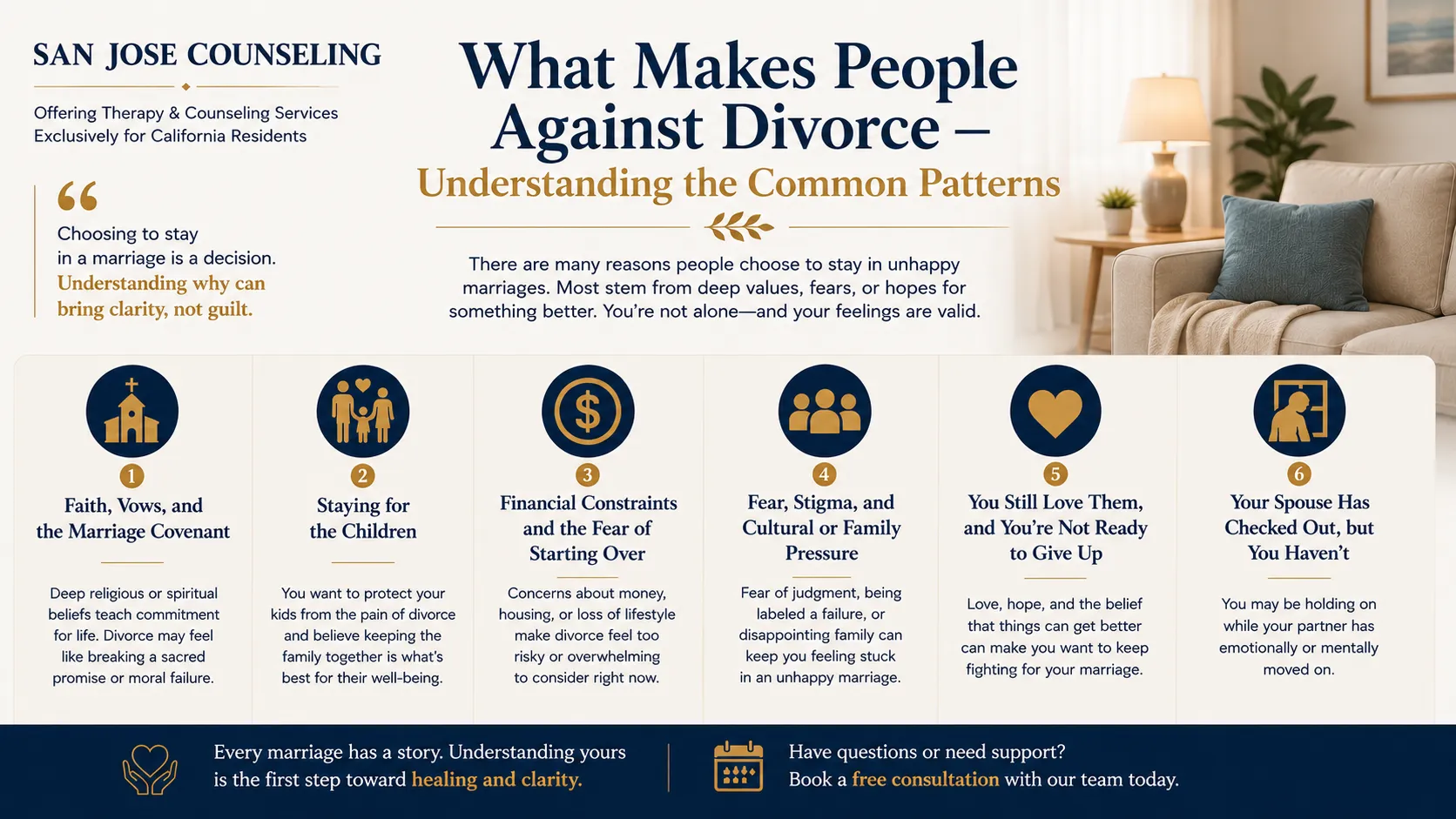
The reasons you're choosing to stay in a troubled marriage are important. For example, choosing to remain in your marriage based on personal religious beliefs or personal commitment (e.g., as part of a "sacred" covenant) is vastly different from remaining in your marriage due to fear, financial dependency, family obligations, or uncertainty about future options.
Understanding your reasons will help determine how you should respond to what's happening in your marriage.
1. Faith, Vows, and the Marriage Covenant
If you feel that divorce would conflict with your faith, your wedding vows, or your concept of a holy covenant, that belief deserves respect.
You may genuinely believe that maintaining your marriage fulfills a vow you made. This doesn't mean you have to ignore the fact that there is pain present.
Couples who experience relationship difficulties can still seek out therapy.
In addition to providing space for couples' faith values and spirituality, research indicates that therapists can provide meaningful therapy by integrating the clients' values.
Therefore, if your faith plays a role in why you do not want a divorce, consider seeking Christian marriage counseling.
2. Staying for the Children
The desire to protect your children could motivate you to stay in a bad relationship; however, it doesn't necessarily mean the outcome will improve simply by remaining in the same environment.
Research shows that continuing exposure to parental conflict significantly impairs
children’s ability to adjust. Instead of staying until the children are 18, it would be better to ask yourself, "Is there anything we can do to create a calmer and safer environment within our home?" Family counseling can help parents find ways to resolve their conflicts and improve communication.
3. Financial Constraints and the Fear of Starting Over
The reasons many people choose to remain in an unhappy relationship involve more than just personal commitment.
Many times, individuals have limited options because they cannot afford to leave their spouse due to high housing costs, lower earning capacity, the loss of potential retirement savings if one spouse leaves (e.g., 401k contributions), or even the sacrifice of a successful career.
These limitations should be considered when making such a difficult decision. Individual therapy can help you identify how you can develop emotional independence, establish boundaries, and plan for how you might realistically start a new.
4. Fear, Stigma, and Cultural or Family Pressure
Many people may fear being single again after a divorce, or fear the process of dating again. In some cases, these fears may be compounded by social pressures (from friends, family, and community), or expectations placed upon you by cultural, ethnic, or religious norms.
In either case, it is important to distinguish whether you remain in the marriage out of fear or out of values. While fear-based choices should be explored, value-based choices deserve respect.
A therapist can provide a safe space to evaluate the impact of social pressures, stigmas, and anxiety on your decision-making.
5. You Still Love Them, and You're Not Ready to Give Up
It is possible that you still love your spouse and truly believe there is something worthwhile in the marriage that needs to be saved.
When both spouses are committed to repairing the relationship by working together to improve communication and build trust, rebuilding the emotional connection in your relationship may still be achievable.
6. Your Spouse Has Checked Out, but You Haven't
You are committed to this marriage, but your spouse is disconnected or unwilling to attend couples counseling.
This does not mean that there are no ways you can create change in your own life. While couples counseling often depends on mutual agreement from both parties involved, you can take individual steps to improve your communication, create healthy boundaries, develop emotional stability, and shape how you respond to the relationship.
The fact that your spouse is choosing not to make changes within themselves does not require you to abandon your commitment.
Evaluating Safety in Staying and Complex Issues
Before deciding how to handle an unhappy relationship is safe enough for you to stay.
Keep in mind that these methods will not help with abuse, coercive control, threats, or other risks that make it dangerous for you to remain in the marriage. Safety must come before marriage repair.
1. Staying in Marriage: Unhappy and Unsafe
If your spouse’s responses scare you, if you feel cut off from friends and family, or if your partner controls your money, movement, communication, and decision-making, then take those issues seriously.
Threatening behavior, intimidating behavior, physical violence, sexual abuse, and coercive control are all signs of an abusive relationship.
You can call the National Domestic Violence Hotline at 1-800-799-SAFE (7233) for confidential support and planning resources for safety.
You may also text START to 88788 or use their online chat. Advocates are available 24 hours a day. If you believe your life is in immediate danger, please call 911.
2. When the Source Is Betrayal, Addiction, or Something Deeper
Infidelity, compulsive sexual behavior, pornography-related issues, and other major relationship wounds may still be workable for someone who is committed to staying in the marriage, but they often require specialized help as opposed to generic advice on coping.
A trauma therapist supports the betrayed partner, while a CSAT helps the unfaithful partner change. When mental health conditions are also involved, you have to assess whether real healing is actually safe and realistic. If safety or progress isn't possible, staying in the relationship may no longer be realistic
Your Real Options When You Won’t Divorce

A troubled marriage can become a happy one again; however, it does not happen automatically. Communication breaks down, resentment builds up, and people go through transitions with unmet needs. Sometimes these things are addressable. Oftentimes people do not seek help until after many years.
John Gottman reported that people wait approximately six years before getting help. This is why knowing the signs you should get marriage counseling can give you insight into when you could use professional help.
Whether you decide to make changes in how you act, set boundaries, build a new level of connection with your partner, or improve your own personal well-being, there is still opportunity for improvement.
Option 1: Work on the Marriage Together (Repair)
If both partners are interested in working together, couples counseling is the most obvious way to start repairing your marriage.
Marriage counseling can help each partner communicate better, reduce recurring conflicts, identify the roots of their issues, and rebuild their emotional connection.
The first step in starting this process is to agree that you want to give your marriage a real effort, schedule your first appointment, and practice structured ways to communicate with each other before, during, and after appointments.
Option 2: Work on Yourself Within the Marriage
If your spouse has no interest in participating in counseling together, or you simply want to improve your overall well-being, independent of what happens with the marriage, then begin focusing on yourself.
"Leaning out" can mean developing your identity, building friendships, developing hobbies/interests, developing a sense of purpose, and building stability separate and apart from your marriage.
Radical Acceptance, a concept from Dialectical Behavior Therapy, means accepting the reality of your situation — including that your spouse may not change — without adding suffering by fighting that reality.
Differentiation of Self, is the capacity to maintain your own emotional stability and sense of self while staying connected to your partner, even under stress.
This can include grief, disappointment, and accepting that your marriage may never develop into what you had envisioned. Individual therapy can assist in this process.
Option 3: Legal Separation
Legal separation is not the same as an informal separation. Legal separation will keep you legally married, yet a court may decide property, debt, spousal support, and parental responsibility issues.
This option might be best suited to people who are opposed to divorce for religious, moral, or financial reasons, but need to place some boundaries on their marriage.
Structured separation is an informal agreement between partners rather than a court order, though you can combine the two if needed.
For example, some couples reside in the same home but maintain completely separate lifestyles; however, this depends on the specifics of your situation.
For a separation to be meaningful, establish agreements regarding finances, parenting, communication, residence, and when to review the status of your marriage.
Without clear guidelines and expectations, separation could serve to further entangle you in an uncertain state of affairs rather than alleviate that uncertainty.
Option 4: The Endurance Path
Waite and her colleagues documented a "marital endurance ethic" among several previously unhappy spouses who reported experiencing improvements in their marriages as adverse external conditions changed over time.
For example, some children became older, job opportunities increased, or other outside pressures decreased.
However, it is essential to recognize that endurance is not the same as being stuck in a bad situation without taking action.
Simply waiting out the problem and allowing negative feelings like resentment, isolation, and despair to intensify is detrimental.
Use endurance as a short-term holding strategy. Do not use it as a long-term solution. If you decide to continue in the current state of affairs, ensure you couple it with self-improvement through healthy boundaries, relationships, and counseling.
Final Thoughts
Being unhappy in your marriage doesn't automatically mean that you've failed. And choosing to stay in the marriage doesn't necessarily mean you're going to suffer.
There is meaningful ground between being completely miserable and leaving. The choices include working on the marriage, developing as a person, setting some limits, or seeking formalized help through a counselor.
Staying isn't weak, leaving isn't betraying someone else, and asking for help isn't losing.
So if you feel like you would be happy if you were out of this marriage but are against divorcing, schedule a free consultation at San Jose Counseling to begin making changes.
Dr. Invia A. Betjoseph
A licensed therapist and certified expert in sex addiction and partner trauma, offering compassionate counseling for individuals and couples. With advanced training in trauma therapy, including EMDR and Emotionally Focused Therapy (EFT), the focus is on providing effective, evidence-based treatment to heal emotional wounds, restore trust, and support lasting recovery.
FAQs
Q1. Is it worth staying in an unhappy marriage?
Sometimes. Staying in a troubled marriage can be okay if the marriage is stable, each person wants to solve their issues, and there is still potential for positive growth.
Enduring passively without making changes will likely continue to create distress.
Q2. How long should you stay in an unhappy marriage before deciding?
There isn’t a set time frame. The amount of time you spend in an unhappy marriage before considering divorce is based on how severe the troubles are, the safety of your marriage, and how much each partner wants to change the marriage.
A therapist can help you evaluate your situation before any important decision.
Q3. Can an unhappy marriage become happy again?
Sometimes yes. Couples can improve communication, reduce resentment, rebuild trust, and grow closer emotionally. Improvement, however, is never guaranteed, especially when only one partner is willing to change.
Q4. What do you do when you're unhappy in your marriage but don't want a divorce?
First, determine why you are unhappy in your marriage. Then look at other options such as couples therapy, individual therapy, setting some boundaries, establishing a clear communication plan, legal separation, etc.
If your marriage is not safe, then find ways to keep yourself and possibly others safe.
Q5. Is staying in an unhappy marriage bad for the kids?
Not necessarily. A child's happiness largely depends on their environment. In most cases, reducing anger and hostility while also maintaining a peaceful and loving atmosphere within their home is much more than whether the parents stay together or separate.