Silent Divorce Explained By California Therapist, Dr. Invia A. Betjoseph

What Is a Silent Divorce? The San Jose Counseling’s Definition
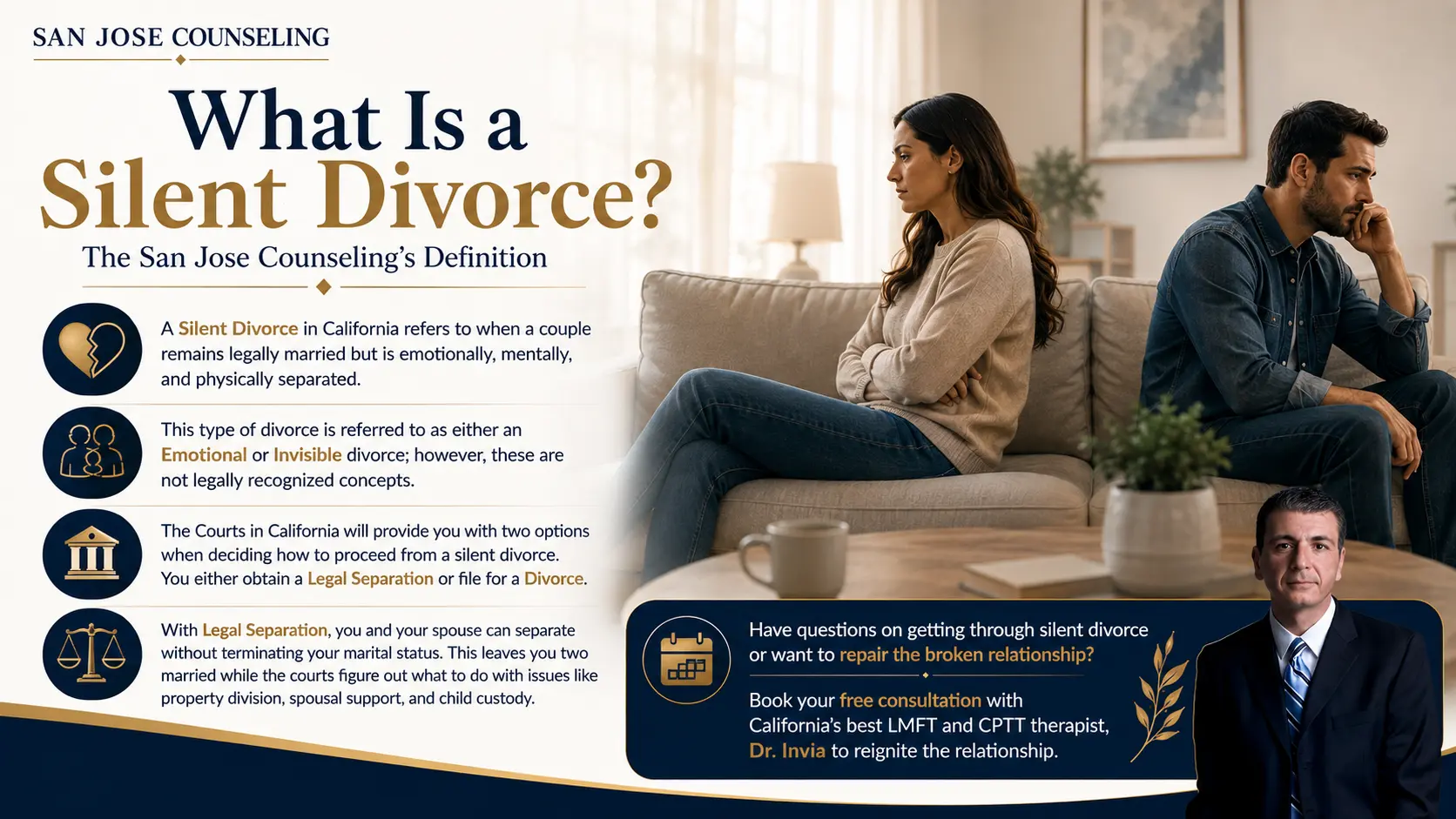
A Silent Divorce in California refers to when a couple remains legally married but is emotionally, mentally, and physically separated.
This type of divorce is sometimes referred to as Invisible Divorce; however, this is not a legally recognized concept.
The courts in California will provide you with two options when deciding how to proceed from a silent divorce. You either obtain a Legal Separation or file for a Divorce. With Legal Separation, you and your spouse can separate without terminating your marital status. This leaves you two married while the courts figure out what to do with issues like property division, spousal support, and child custody.
Silent Divorce vs. Emotional Divorce vs. Roommate Marriage vs. Sleep Divorce
These terms may have overlapping meanings; however, these terms are not always used interchangeably.
An "emotional divorce" generally refers to the actual emotional separation of two people from one another. A "silent divorce," on the other hand, generally refers to a marriage that appears to continue outwardly in all respects yet has an emotional separation occurring. The term "roommate marriage" tends to emphasize how the couple operates daily, and the term "sleep divorce" typically refers to couples who sleep apart (often for scheduling or sleep issues) rather than continuing their relationship as a single unit.
One useful way to think about the relationship between these terms is as a possible progression, rather than a fixed sequence of steps:
Emotional Divorce —>roommate-like relationship —> Silent Divorce
This does not mean that each step must occur. For example, there could be couples where the couple sleeps apart yet are still emotionally connected. Likewise, couples could live together in a manner similar to roommates, even if neither spouse has decided that the marriage is no longer viable.
| Aspect | Silent Divorce Emotional distance within marriage | Emotional Divorce Emotional bond has substantially weakened | Sleep Divorce Partners sleep separately | Roommate Marriage Practical household partnership |
|---|---|---|---|---|
| Main Idea | Marriage continues while emotional connection has largely faded | Emotional bond has substantially weakened or ended | Partners sleep separately | Marriage functions primarily as a practical household partnership |
| Legal Status | Legally married unless a formal proceeding changes that | No specific legal status | No specific legal status | No specific legal status |
| Emotional Connection | Usually significantly reduced | Severely reduced or absent | May be healthy or strained | Often limited |
| Intimacy | Often reduced emotionally and physically | Usually substantially reduced | Not necessarily affected | Often limited |
| Reversibility | May be possible, depending on the relationship | May be possible, depending on circumstances | Often readily reversible | May be possible |
| Conflict Level | May involve little conflict or recurring unresolved conflict | May range from high conflict to indifference | Usually unrelated to conflict | Often low or transactional |
| By Choice | May be conscious or gradual | May be conscious or gradual | Usually a deliberate sleep arrangement | May develop gradually or be consciously accepted |
| Example Scenario | “We live together but we've quietly drifted apart.” | “I no longer feel emotionally married to my spouse.” | “We sleep in separate rooms because we sleep better that way.” | “We co-parent, manage the home, and rarely connect as partners.” |
Silent Divorce vs. Roommate Marriage vs. Sleep Divorce: Understanding the Spectrum
A "Roommate Marriage" refers to a union that lacks intimacy. While both "Silent Divorce" and "Roommate Marriage" are examples of emotionally disconnected relationships, they occur at different stages.
The difference lies in the reason for the separation. Couples who choose to sleep in separate beds are often simply trying to improve their sleep quality; nevertheless, they have chosen to live together. Silent divorce, on the other hand, indicates that the couple's emotional connection has significantly deteriorated.
9 Signs You May Be Living in a Silent Divorce
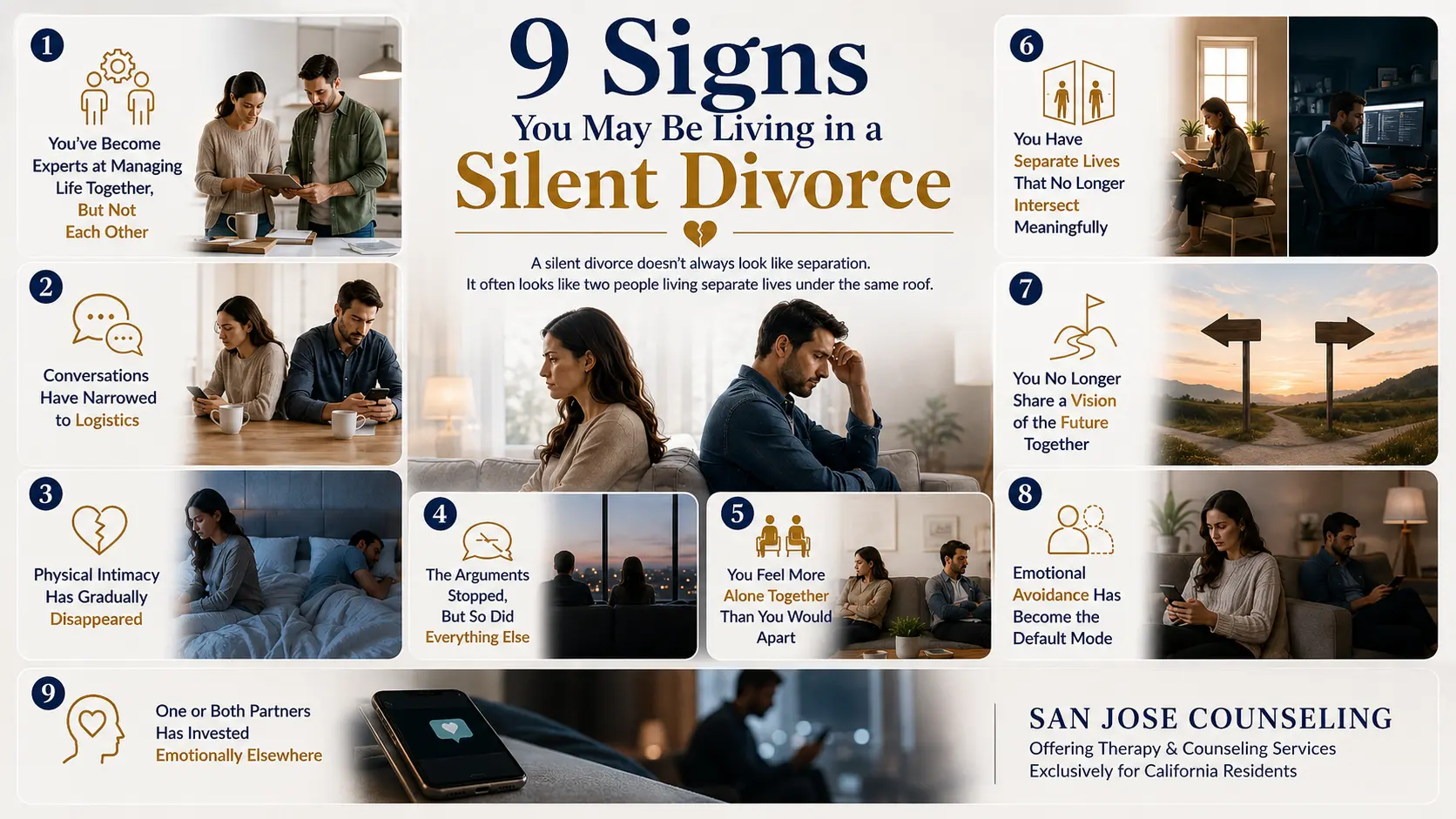
These signs do not diagnose you or your partner. The goal is to become aware of these symptoms and not to assign blame. Many couples have healthy marriages on the surface that have eroded their emotional connection over time through work, raising kids, money issues and social obligations.
1. You've Become Experts at Managing Life Together, But Not Each Other
High-functioning couples manage the day-to-day lives of being good parents, managing finances, maintaining social connections, and achieving success in their careers. However, because the house seems to be in order 24/7, this functional competence can easily mask the emotional absence slowly creeping in.
It's even easier to miss this disconnect in the fast-paced culture of the Bay Area and Silicon Valley, where intense career demands naturally take over your daily life. Therefore, one sign of a silent divorce is that the house runs smoothly but no one pays attention to your emotional wellbeing.
2. Conversations Have Narrowed to Logistics
In time, the conversation may narrow down to only discussing your schedule and logistics such as, "what time does your child get off school?" "When will we pay the rent?" or "Do I need to pick up anything at the store?" and nothing else.
There aren't discussions about what you feel inside: fear, desire, disappointment, or hope for the future. Vulnerability and sharing your internal experiences create intimacy. Simply providing each other with logistical information creates a household partnership, not an emotionally connected marriage.
3. Physical Intimacy Has Gradually Disappeared
Physical disconnection involves lessening sexual intimacy (or other forms of intimacy) as well as the elimination of everyday affection. This includes touching, sitting close together, holding hands, etc., and/or engaging in spontaneous, unplanned physical contact.
While a decrease in intimate behaviors during illness, post-partum recovery, grief, or extreme work-related stress is not necessarily indicative of a "silent divorce," it becomes a cause for concern if the decreased behavior continues even though the circumstance has resolved itself.
In this case, what makes the change concerning is the continuation of the behavior over time and its becoming the norm. It is the direction and meaning of the change that is important, not the frequency of intimate behaviors per se.
4. You Feel More Alone Together Than You Would Apart
Feeling isolated while having a partner nearby who is emotionally unavailable can exacerbate feelings of loneliness. Feeling unable to discuss fears, needs, or meaningful events with your partner creates a unique form of isolation.
Studies show that individuals experiencing distressed relationships/low-quality relationships experience poorer mental health outcomes; however, it cannot be inferred that emotional disconnection in marriage results in greater depression or anxiety than being single.If persistent anxiety continues, please seek out assistance from a licensed mental health therapist.
5. The Arguments Stopped, But So Did Everything Else
Not arguing is not always evidence of harmony. Couples sometimes stop arguing because they are no longer trying to resolve conflicts or connect emotionally.
Gottman describes stonewalling as withdrawing from an exchange or shutting down during an interaction due to feeling overwhelmed.
He identified stonewalling as one of the four horsemen associated with marital dissolution. The absence of anger when conflict ceases and instead yields to continued disengagement suggests a possible withdrawal of emotions rather than a peaceful coexistence.
6. You Have Separate Lives That No Longer Intersect Meaningfully
When separate friendships, vacations, hobbies, or routines occur (and there is no attempt to reconnect), that is when the potential for harm exists. When significant life decisions are being made by each person independently, when you and your spouse do not include each other in long-term planning, and when the way we speak to one another changes from "we" to "I"; that is when a problem exists.
According to attachment theory, repeated disconnections create barriers that lead to protective distance and detachment. Further research also supports the idea that withdrawn communication is linked to partner withdrawal and relationship dissatisfaction; however, the patterns vary from person to person.
7. You No Longer Share a Vision of the Future Together
Sometimes, day by day, you realize you are no longer sharing a vision for your future together. This can include retirement plans, making large purchases, moving to new locations, making decisions regarding children, or other long-term goals. They are no longer discussed as if you would be doing them together.
In many cases, this absence is more revealing of how far apart two partners have grown than it is a statement of what is wrong. In fact, recognizing this lack of shared future can encourage couples to reflect on whether or not they would like to work on building connections again and possibly see a professional counselor for marriage therapy.
8. Emotional Avoidance Has Become the Default Mode
Emotional avoidance is defined as consistently avoiding discussions that involve vulnerability or conflict. Emotional avoidance allows resentments and disappointments to build up since needs remain unexpressed. Since emotional avoidance is consistently being used, partners may begin to employ additional defenses such as defensiveness, contempt, etc., furthering the original pattern of avoidance.
According to Dr. John Gottman's Four Horsemen concept, criticism, contempt, defensiveness, and stonewalling are all negative interpersonal interactions that predict marital breakdown. While the eventual progression into this type of behavior is not inevitable, consistent emotional avoidance can cause an individual to become increasingly emotionally disconnected.
9. One or Both Partners Have Invested Emotionally Elsewhere
When an individual feels emotionally disconnected from their spouse, they will often begin investing time and emotions into other relationships, whether through friendships, work relationships (i.e., colleagues), extended families, new hobbies, etc.
The reason for this increased investment of time and emotion typically isn't because an individual has made a conscious choice to leave the marriage, but because of a perceived loss of emotional attachment within the marriage—a pattern that can show up across different attachment styles, not one in particular).
What Causes a Silent Divorce? The Root Patterns a Therapist Identifies
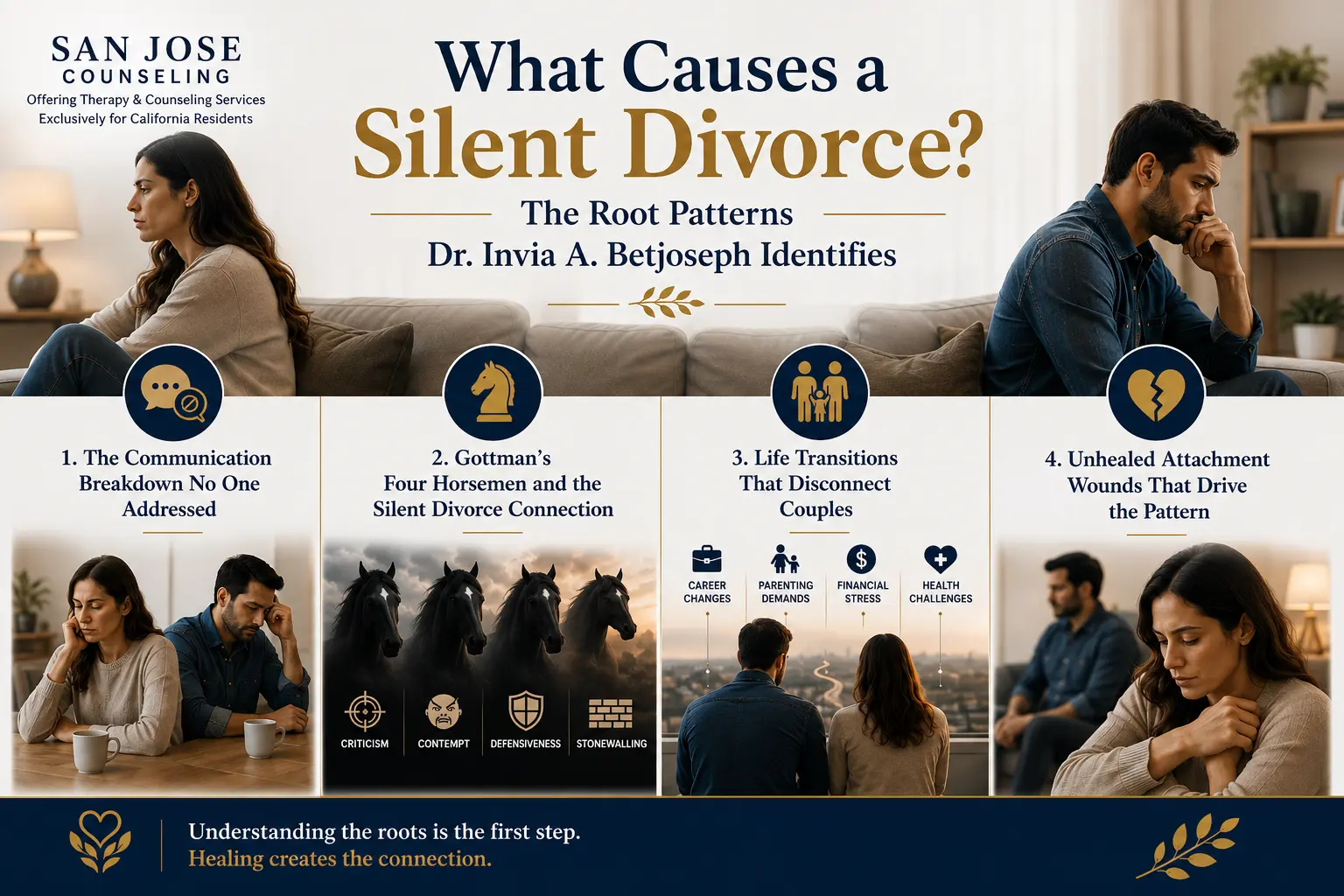
A silent divorce rarely happens as a result of a single event. Rather, it develops through a combination of small relational patterns that build upon each other to create difficulty in connecting emotionally.
The Communication Breakdown No One Addressed
When partners do not resolve conflicts, their resentment grows; resentment leads to greater partner avoidance; avoidance results in less disclosure of feelings and thoughts; and eventually, a state of withdrawal occurs, resulting in silence.
According to The Gottman Institute, couples typically wait an average of six (6) years before seeking outside professional assistance to address relational issues. This delay in discussing the relational issues gives destructive relational patterns ample opportunity to develop and solidify.
Gottman's Four Horsemen and the Silent Divorce Connection
Criticism, contempt, defensiveness, and stonewalling are all identified by Gottman as contributing factors to the breakdown of relationships. In addition, Gottman's longitudinal research indicates that when individuals in a romantic relationship engage in combinations of these four behaviors, there exists a significant probability that they will experience divorce.
Stonewalling is particularly related to silent divorces since this behavior involves completely withdrawing from the interaction process, shutting off emotionally, or refusing to respond to their partner when feeling overwhelmed by conflict. Eventually, repeated withdrawal can transform what once was conflict-avoidance into a state of complete disconnection, or emotional disengagement.
Life Transitions That Disconnect Couples
While transitions such as having children, entering a new phase in your career, or moving to a different location require a great deal of effort from a relationship, they do not necessarily cause a silent divorce. Rather, they can uncover or magnify unfulfilled relational requirements if there is pre-existing strain in connection. While couples may adjust to the practical aspects of a new transitional stage without making an effort to meet the emotional needs within the relationship, the emotional disconnection can continue.
Unhealed Attachment Wounds That Drive the Pattern
Emotionally focused therapy is an attachment-based approach that examines how couples respond emotionally to emotional distance or threat. In response to these emotional states, one partner may "pursue" for connection, comfort, or reassurance while the other partner may "withdraw" to cope with their own distress.
As this pursuer-withdrawer pattern solidifies, it can lead to a vicious cycle where each time the pursuing partner tries to reconnect, the withdrawing partner's desire to avoid further conflict results in even greater withdrawal. This ultimately produces what many call an "emotional silence,” which often defines a silent divorce.
Can a Silent Divorce Be Healed? What Therapy Actually Does — and Doesn't
In many cases, yes— silent divorces can be healed if both partners remain willing to engage. Earlier intervention typically gives couples more opportunity to change their daily pattern of interaction before they have completely disconnected emotionally.
While therapy cannot guarantee that you and your partner will reconcile or restore your relationship in every case, it is intended to help you both identify destructive patterns, enhance your emotional connection with one another, improve your communication, and make informed decisions about whether you want to continue the relationship.
Emotionally Focused Therapy (EFT): Rebuilding Secure Attachment
Developed by Dr. Sue Johnson, Emotionally Focused Therapy (EFT) is an evidence-based approach that centers around issues such as attachment, emotional responsiveness, and repeated cycles of interaction.
In cases where couples experience disconnection and lack of emotional connection, the therapist will attempt to identify the cycle of pursuing/withdrawing, uncover the source of these emotional responses and attachment needs, and assist the couple in responding to each other differently than they do now.
A meta-analysis of RCTs demonstrated a moderate effect size for emotionally focused couples therapy in improving overall relationship satisfaction with gains generally well maintained at follow-up (Spengler et al., 2024).
The Gottman Method
The Gottman Method is a well-researched structured method for working with couples. This method provides both assessments and interventions to address friendship, conflict resolution, intimacy, and shared meaning.
The Gottman Method uses its "Sound Relationship House" as a framework to build love maps, share fondness and admiration, turn towards each other's bids for connection, manage conflict, create shared meaning, build trust, and strengthen commitment. It can be especially helpful if couples want to develop practical skills for communicating effectively and resolving conflicts.
However, since EFT (Emotionally Focused Therapy) is centered around attachment distress and emotional disconnection, EFT is often a stronger clinical fit than the Gottman Method for couples in San Jose whose primary concerns are attachment distress and emotional disconnection.
Discernment Counseling: For When You Are Not Sure You Want to Try
Unlike traditional couples therapy, Discernment Counseling is designed specifically for "mixed agenda" couples where one member of the couple is actively considering divorce while the other remains committed to saving their relationship.
Discernment counseling aims at providing clarity and confidence about the next steps—whether to work on the relationship, separate, or take more time—rather than fixing the relationship itself.
Discernment counseling typically involves 1 to sessions, based on the University of Minnesota model developed by Dr. Bill Doherty. Couples should seek out discernment counseling when they are truly undecided about pursuing reconciliation or divorce. Couples who have made the decision together to work on their relationship should seek couples therapy instead.
When Only One Partner Is Ready: What Individual Therapy Can Still Accomplish
Even if the other member of the couple does not want to attend couples therapy, individual therapy can offer important assistance. The therapist may help the client understand their own attachment style, recognize behaviors that reinforce disconnection in interactions, establish healthier emotional boundaries, and express needs to their partner in ways that do not exacerbate conflict.
It is important to note that individual therapy cannot force an unwilling partner into attending therapy or guarantee that the couple will change as a result of one person’s new responses. However, by gaining a clearer understanding of one’s own patterns, a person can begin to interact with their partner more consciously—whether the eventual goal is reconciliation or separation.
Dr. Invia A. Betjoseph
A licensed therapist and certified expert in sex addiction and partner trauma, offering compassionate counseling for individuals and couples. With advanced training in trauma therapy, including EMDR and Emotionally Focused Therapy (EFT), the focus is on providing effective, evidence-based treatment to heal emotional wounds, restore trust, and support lasting recovery.
FAQs
Q1. Is a silent divorce legally recognized in California?
No. Silent Divorce is not a legal status in California. California has two formal process options: Divorce and Legal Separation. Both of these can create a court order regarding property, support, and children.
Q2. How long can a couple live in a silent divorce before the emotional damage becomes permanent?
While there may be a point where persistent disconnection becomes increasingly difficult to reverse, research has not established a definitive amount of time that makes this impossible.
Q3. What are the most effective therapy approaches for healing a silent divorce?
Research indicates that Emotionally Focused Therapy (EFT) and behaviorally based approaches (such as Integrative Behavioral Couple Therapy) are among the most effective treatments for relationship distress. The best option for any couple depends on their specific interaction patterns, goals, and clinical circumstances.
Q4. Can one partner address a silent divorce if the other refuses to seek help?
Individual therapy can assist you in understanding your own interaction patterns, learning new ways to communicate with your partner, and making more informed decisions about your relationship. However, individual therapy cannot force your partner into therapy, nor can it guarantee that changes will occur within the marriage.