Pre-Marital Counseling: The 32 Questions That You Need to Ask By Dr. Invia A.

Life is More Stressful Than Ever—Making Pre-Marital Counseling Essential Than Ever
Relationships today are under more pressure than they used to be—money is tighter, careers are more demanding, and social media makes it easy to compare your relationship to everyone else's.
That's part of why it helps to understand what premarital counseling actually is, and what it can do for you.
Premarital counseling helps you build better communication, boundary setting and conflict resolution skills, which research has linked to lower divorce rates and better overall wellness.
Stable marriages (i.e., ones that last) have also been linked to better physical health and longevity. Ongoing stress, though, tends to wear couples down over time and is a common factor in breakups and divorces.
Between our fast paced lifestyles, economic difficulties and social pressures, it's easy for misunderstandings occur more often when partners do not take the opportunity to discuss their expectations. Some benefits of premarital counseling include:
- Helping to prevent confusion regarding roles, expectations and long-term plans
- Bringing up hidden assumptions about happiness and satisfaction
- Creating a mutual understanding of one another's needs and values
- Developing effective communication skills to handle difficult conversations
- Enhancing your mental/emotional well-being before you say "I do."
This process prepares you not only for a wedding, but for a successful and enduring marriage. This piece discusses pre-marital counseling in detail.
For your questions on California-pre-marital counseling, you can book a free consultation with California’s best LMFT (licensed marriage and family therapist) Dr. Invia.
Pre-Marital Counseling Topics and Questions
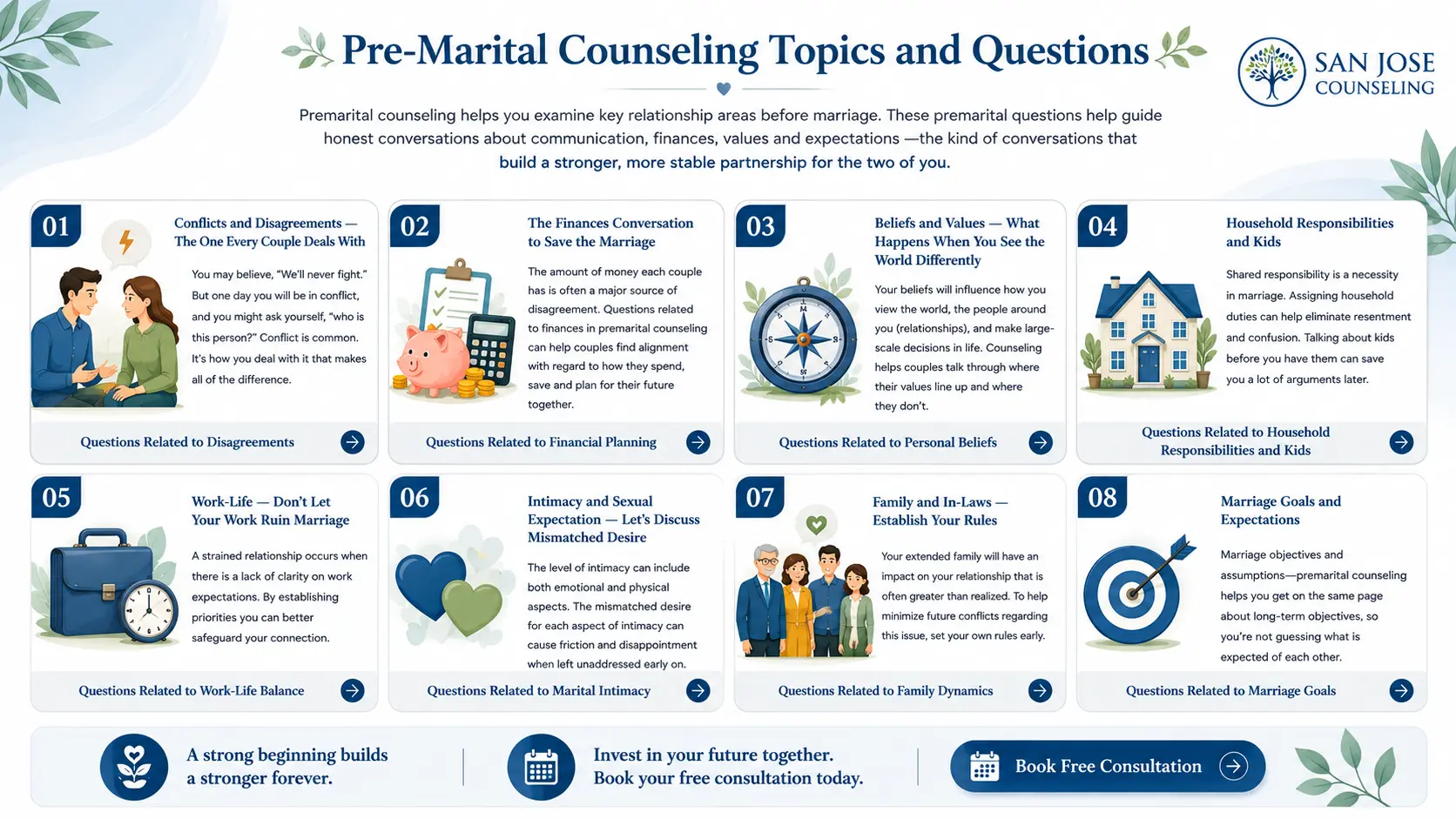
Premarital counseling helps you examine key relationship areas before marriage. These premarital questions help guide honest conversations about communication, finances, values and expectations —the kind of conversations that build a stronger, more stable partnership for the two of you.
Conflicts and Disagreements — The One Every Couple Deals With
You may believe, "We'll never fight." But one day you will be in conflict, and you might ask yourself, "who is this person?" Conflict is common. It's how you deal with it that makes all of the difference. How you learn to communicate through conflict can make or break a marriage.
Questions Related to Disagreements:
1. How do you typically react when you're angry or hurt?
2. What does a healthy argument mean to you?
3. How would you want us to address unresolved disagreements?
4. In what way do your habits for your physical health (sleep, stress management, mental health) influence how you react in conflict?
The Finances Conversation to Save the Marriage
The amount of money each couple has is often a major source of disagreement. Questions related to finances in premarital counseling can help couples find alignment with regard to how they spend, save and plan for their future together. If there is no financial agreement prior to marriage, it may continue to cause tension between the two partners.
Questions Related to Financial Planning:
5. How will we manage our budget, debt and savings?
6. What do you expect regarding how much money will be spent versus saved as part of lifestyle choices?
7. Should we have joint finances, individual finances or something else?
8. Do we want to use insurance, invest in stocks/bonds and/or make plans for retirement or other long term goals?
Beliefs and Values — What Happens When You See the World Differently
Your beliefs will influence how you view the world, the people around you (relationships), and make large-scale decisions in life. Premarital counseling for Christians, or therapy in general, helps couples talk through where their values line up and where they don't so that there is less of a chance for future disagreements.
Questions Related to Personal Beliefs:
9. What are your top values and how do these values determine your actions and behavior?
10. How involved will religion/spirituality be in our daily lives together?
11. How will we handle our differences in belief systems?
12. What is your view on some of the larger issues that impact our relationship (e.g., roles within the family, ethics)?
Household Responsibilities and Kids
Shared responsibility is a necessity in marriage. Assigning household duties can help eliminate resentment and confusion.Talking about kids before you have them can save you a lot of arguments later.
Questions Related to Household Responsibilities and Kids:
13. How do you think we should divide household duties?
14. Where would you like to live and where are your parents/family members located?
15. Do you want children and if so how many?
16. Who will handle parenting responsibilities and who would manage our finances?
Work-Life — Don’t Let Your Work Ruin Marriage
A strained relationship occurs when there is a lack of clarity on work expectations. By establishing priorities you can better safeguard your connection.
Questions Related to Work-Life Balance:
17. Will both of us be employed and how will we spend our time together?
18. If either of us has an opportunity to change careers or stop working what are the implications for the marriage?
19. Does one of you feel like you have to choose between a successful career and a healthy marriage?
20. How will we deal with job related stress?
Intimacy and Sexual Expectation — Let’s Discuss Mismatched Desire
The level of intimacy can include both emotional and physical aspects. The mismatched desire for each aspect of intimacy can cause friction and disappointment when left unaddressed early on.
Questions Related to Marital Intimacy:
21. How do you define intimacy beyond just a sexual relationship?
22. What is your expectation regarding frequency and boundaries around sexual activity?
23. How comfortable is it for each of us to talk about things that don't feel right in the relationship?
24. In what way have previous experiences shaped your expectations surrounding marital sex?
Family and In-Laws — Establish Your Rules
Your extended family will have an impact on your relationship that is often greater than realized. To help minimize future conflicts regarding this issue, set your own rules early.
Questions Related to Family Dynamics:
25. Should both of our extended families be involved in our daily lives?
26. How would you like us to resolve any disagreements with each other’s relatives?
27. Which family traditions or expectations are a priority for you?
28. How should we address sensitive issues related to either one of our families?
Marriage Goals and Expectations
Marriage objectives and assumptions—premarital counseling helps you get on the same page about long-term objectives, so you're not guessing what is expected of each other.
Questions Related to Marriage Goals:
29. What does a successful marriage look like to you?
30. What are your personal and joint life goals?
31. How do you want to handle major changes or challenges in the future?
32. What responsibilities/roles do you think each partner should have when married?
Begin a Journey to a Happy Marriage with Pre-Marital Counseling in California
Premarital counseling will give you the tools you need in order to have a stronger, more satisfying relationship and lower your risk for divorce. Premarital counseling is an opportunity for you to invest not just in your wedding but in your marriage.
With stress and disconnection from work and other areas of life weakening relationships every day, developing communication skills, conflict resolution, and emotional awareness now will help you succeed long term.
Book your free consultation today at San Jose Counseling with an LMFT and CSAT licensed therapist.
Dr. Invia A. Betjoseph
A licensed therapist and certified expert in sex addiction and partner trauma, offering compassionate counseling for individuals and couples. With advanced training in trauma therapy, including EMDR and Emotionally Focused Therapy (EFT), the focus is on providing effective, evidence-based treatment to heal emotional wounds, restore trust, and support lasting recovery.
FAQs
Q1. What happens in pre-marital counseling?
You talk about how to communicate with your spouse. You discuss your financial situation together. You find out if there is some difference of opinion regarding your value systems. The two of you go through a series of questions that a therapist has designed as part of a structured premarital counseling program.
Q2. What is the 5 5 5 rule in marriage?
Some couples use what's called the "5-5-5" rule to figure out if something's worth fighting over: ask yourself if it will still matter in five minutes, five months or five years.
Q3.Is premarital counseling a good idea?
Couples who participate in premarital counseling tend to have improved communications skills. Couples tend to clarify their expectations for life. Participating in premarital counseling tends to reduce the amount of conflict couples experience in the future. Couples tend to develop a stronger foundation prior to entering into marriage.
Q4. What questions are asked in pre-marital counseling?
Common premarital counseling questions cover:
- Conflict and communication
- Finances and goals
- Values and beliefs
- Intimacy and family dynamics