How Do I Heal from Infidelity and Save Marriage in California?
They left the phone unlocked, then came the call, then the admission, and the sinking feeling in your stomach. Afterward, sleep never came; you felt unsafe, and questions kept looping in your head even at 3 a.m.
Despite this devastation, it’s still not contradictory to want to save your marriage. From experience, marriages can survive infidelity, but it needs more than apologies and willpower.
This guide discusses betrayal trauma, rebuilding trust, reconnecting, and how therapy can help to ultimately restore a marriage damaged by infidelity. For a personalized approach, book a free, confidential consultation with San Jose Counseling.
Can a Marriage Really Survive Infidelity? What Actually Determines the Outcome
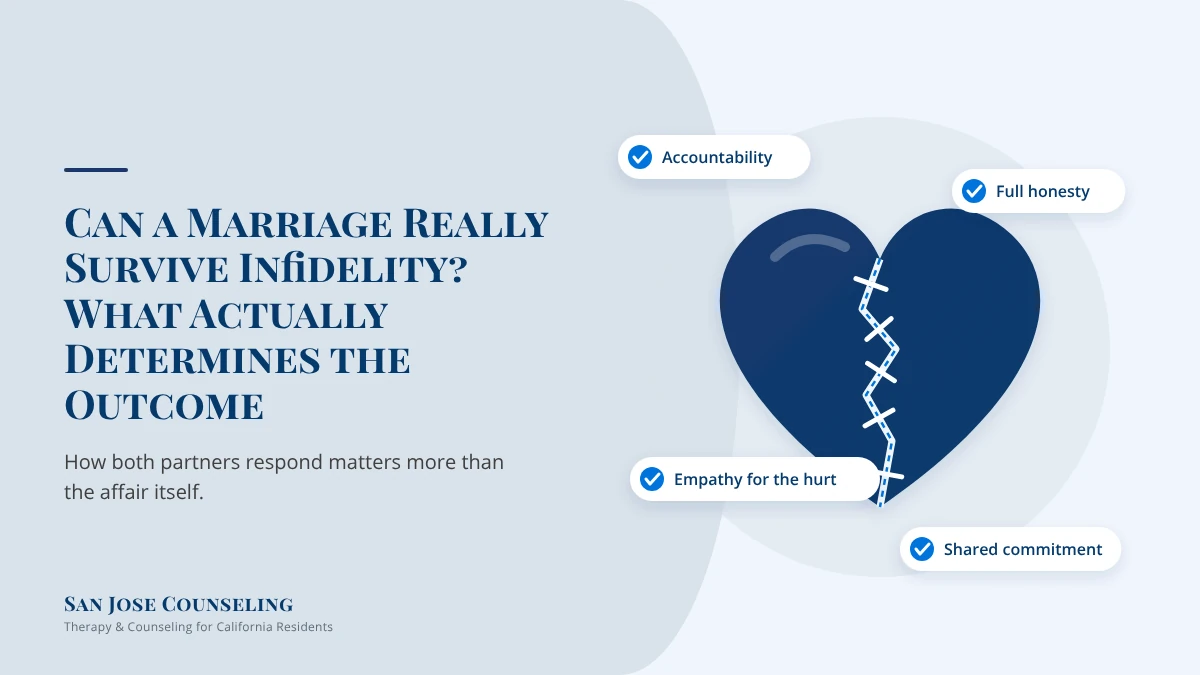
Infidelity doesn't necessarily have to be the death of your relationship. Some couples work through the hurt when both partners stay focused on repairing the damage, not fighting constantly.
If you're wondering, "Is my marriage worth saving?" The answer is that it will depend less on whether or not there was an affair and more on how things go after the affair.
Rebuilding trust is hard work, but progress can start happening sometimes within months of couples and marriage counseling. The goal is returning to an honest marriage.
The Two Non-Negotiables Before Healing Can Begin
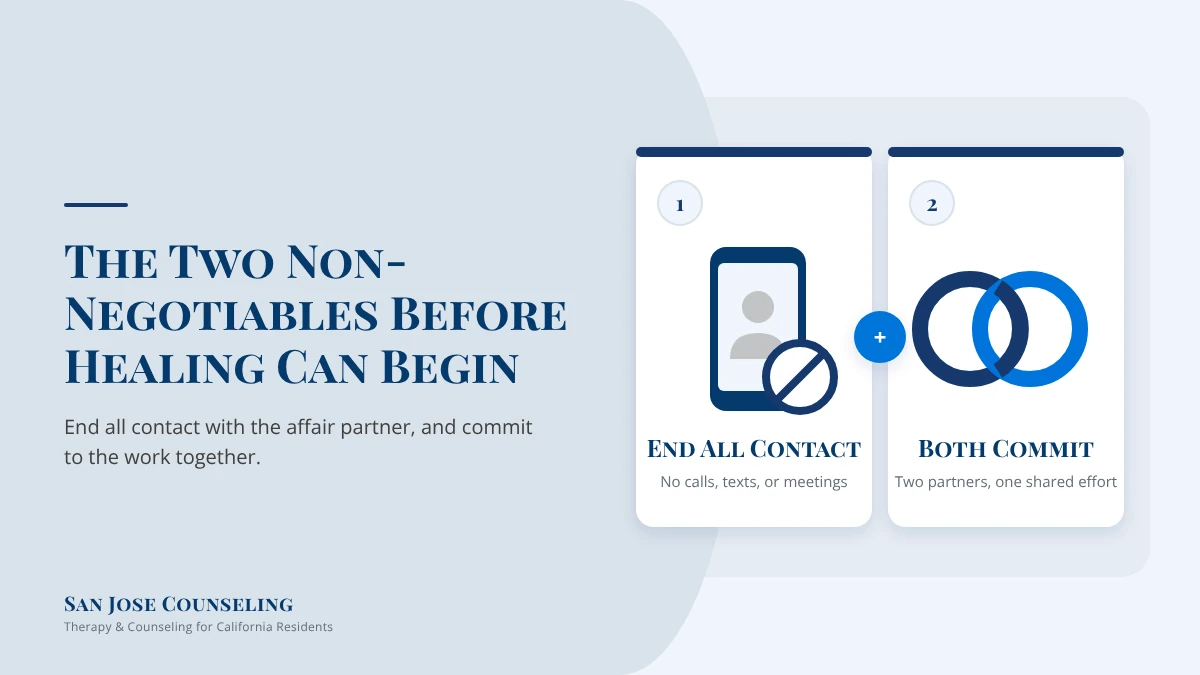
Repairing a relationship requires that there be complete cessation of all affairs (physical, emotional, or digital) and for both parties to agree to work on repairing the damaged relationship.
The unfaithful person must be transparent and accountable for their actions. The betrayed individual may never feel ready to begin rebuilding the relationship and may take time, but will eventually have to choose to do so.
When Reconciliation Isn't the Right Path
Reconciling is not always possible. Ongoing abuse, the refusal to be truthful about an affair, lack of remorse for what has happened, and continued dishonesty (and other behaviors) make it impossible to make amends.
When couples doubt whether they want to remain married, Discernment Counseling provides a process for deciding on reconciliation, separation, or divorce.
Deciding not to reconcile does not mean you have failed. The decision to not continue a relationship can be difficult, but divorce recovery therapy will help with the healing.
The Two Non-Negotiables Before Healing Can Begin
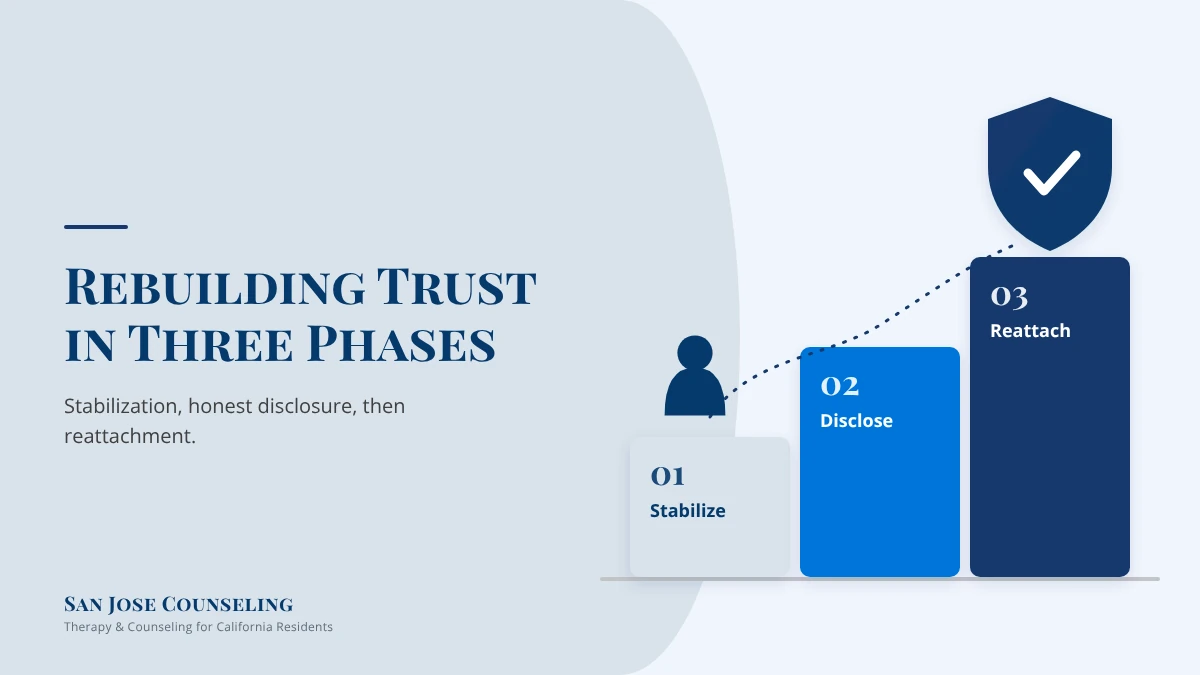
Rebuilding trust in relationships follows a specific sequence. First, the couple must stabilize their crisis. Second, they must establish honest disclosure.
Third, work toward re-attachment. Skipping a stage, such as going after closeness before disclosure, usually causes the couple to go back into conflict.
Phase 1 — Crisis Stabilization and Safety (The First Days)
The initial stages of an affair are often filled with crisis for both partners involved. Therefore, it is essential to stabilize the situation before attempting to solve problems related to infidelity.
Establishing some basic emotional safety, agreeing on time-outs when emotions become too high, establishing boundaries by postponing major irreversible decisions, as well as separating from the affair partner while remaining emotionally accessible but not defensive can be useful.
Also, individual therapy can provide the betrayed spouse with tools to manage their emotional distress prior to starting couple's therapy.
Phase 2 — Honest, Therapeutic Disclosure
How the truth emerges matters. Drip or staggered disclosures, where information is provided incrementally over time (weeks), may increase an individual's distress and reduce credibility.
A more therapeutic approach to disclosing the betrayal involves creating a single, organized, and guided account by a licensed therapist.
Even when the betrayed partner wants to ask 10 questions to the cheating spouse, a therapeutic approach prevents disclosing unnecessary, graphic details that harm recovery.
Phase 3 — Atonement, Attunement, and Reattachment
Once truth and safety are established, the couple may move into atonement (genuine remorse, full accountability, and no blame-shifting), followed by attunement (listening and acknowledging each other's feelings and unmet needs), and finally reattachment.
This involves rebuilding closeness on an emotional and physical level to restore the couple's connection and sense of security.
Rebuilding Emotional and Physical Connection
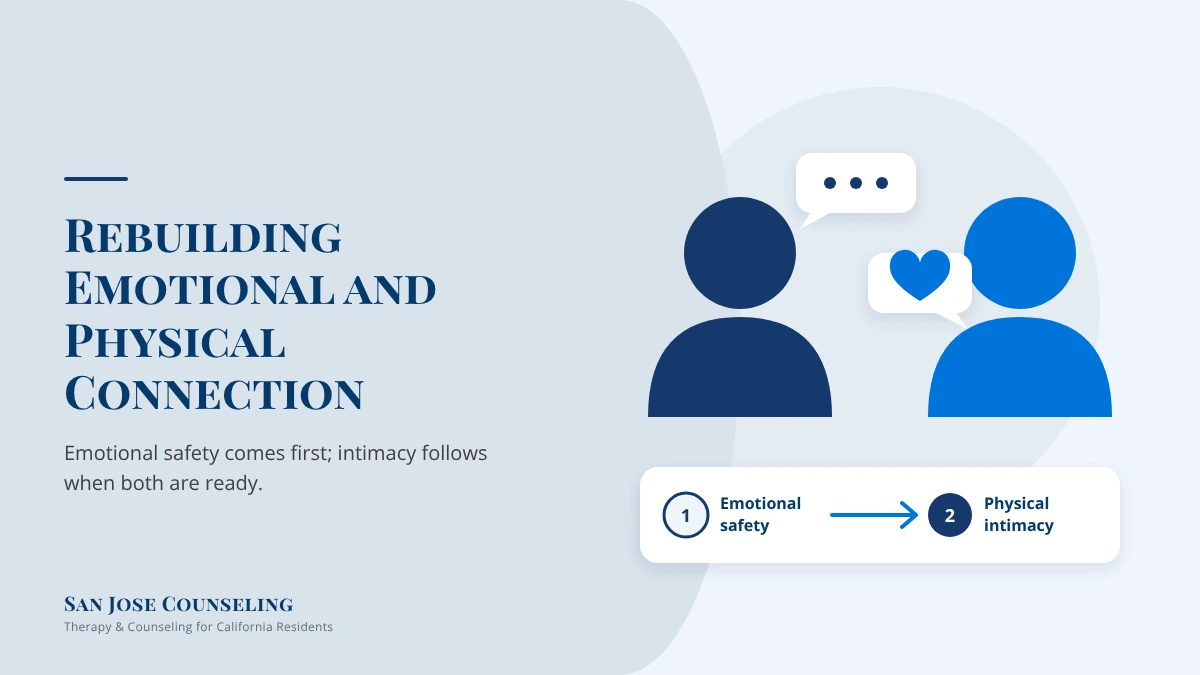
After an affair has occurred, it is necessary to rebuild the connection over time while establishing safety with regard to emotions prior to intimate physical contact.
Once trust is established as the base of the relationship, no one should force the other into sexual activity sooner than they feel ready.
Many couples find that there is a more genuine connection after recovering from an affair than existed before.
Rekindling Intimacy Without Rushing It
Start with lower levels of emotional intimacy through conversation, shared activities, and small, regular gestures of care. Reconnecting physically is best done after both partners feel emotionally safe and not at a previously agreed-upon time.
The betrayed partner will need to decide for themselves as to when they are ready to reconnect.
Any long-standing issues with sex or intimacy that were contributing factors to the distress of your relationship should be addressed during the recovery process so that you do not overlook them.
Communication Tools That Prevent Re-Wounding
Recovery dialogue needs some structure to avoid revisiting old wounds. Rather than attacking, identify what is causing your anger and how it relates to other emotions you may be feeling.
Also, if either partner is emotionally overwhelmed, they should take a break. Communication exercises for couples offer many ways to build new habits that help partners validate one another's feelings and repair the relationship.
Early professional counseling can help couples develop healthy validation and repair strategies while avoiding using therapy as another battleground.
When Infidelity Points to a Deeper Issue — Compulsive Sexual Behavior
Sometimes, infidelity comes from more than just cheating; it can be an addiction. Chronic affairs, excessive porn use, secret sexual behavior, and an inability to stop these issues may indicate compulsive sexual behavior.
To recover from this type of struggle, both partners need to do specific recovery work. The non-addicted partner needs to find a therapist who specializes in Betrayal Trauma, while the addicted partner would be best served by finding a therapist specializing in Sex Addiction Treatment.
Bonus: The Sexual Addiction Screening Test (SAST) is a good tool for identifying these kinds of patterns.
How Therapy Heals Infidelity — The Evidence-Based Approaches SJC Uses
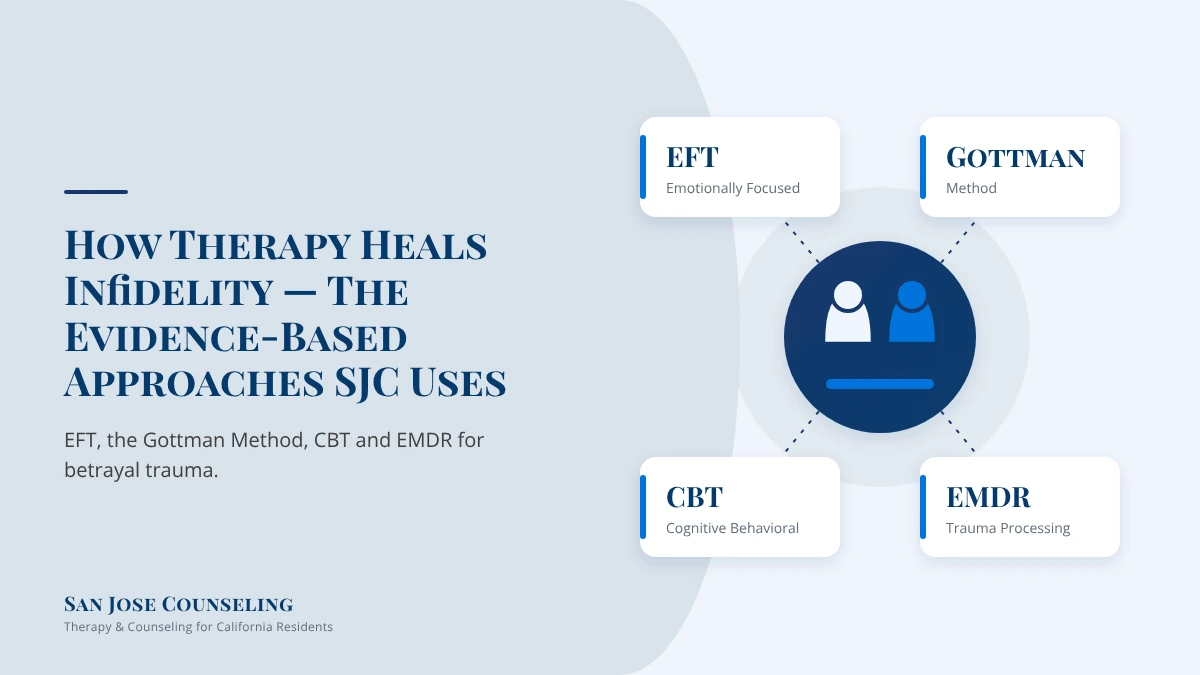
Couples may be at a loss for how to manage their relationship after an affair. Therapists help provide boundaries in times of chaos.
The therapist can direct the process of disclosing all the details of the infidelity, identify traumatic responses (if they occur), and foster safety in communication.
Rather than offering generic advice, therapists recommend different forms of therapy for a more targeted, effective approach. San Jose Counseling has identified many ways marriage counseling can help.
Emotionally Focused Therapy (EFT) and the Attachment Injury Model
Emotionally focused therapy (EFT) views an affair as an "attachment injury", which means a break in the relational bond, as opposed to just a broken rule.
The process of EFT is designed to help couples find the deeper feelings, fears, and attachment needs that are behind their angry behavior or withdrawal.
By validating both partners, EFT helps them move away from destructive patterns of blame and defensiveness, allowing for greater emotional closeness. In addition, this process provides a basis for establishing a new, strong sense of trust over time.
The Gottman Method, CBT, and EMDR
The Gottman Method emphasizes building healthy friendship and communication in the relationship as they address the betrayal.
Cognitive Behavioral Therapy (CBT) identifies negative thought patterns, such as "They'll never change" and "I can't ever believe anything," and helps replace those rigid beliefs with more flexible, balanced thinking.
The Betrayed Partner may experience disturbing memories or intrusive images that are part of their traumatic event. For this reason, Eye Movement Desensitization & Reprocessing (EMDR) is a structured approach to treating trauma by helping them process and reduce the distress from these memory disturbances.
San Jose Counseling provides EMDR Therapy as part of its clinical service, and our aim isn’t to erase what happened, but to reduce the power it has over your reactions.
How San Jose Counseling Can Help Save Your Dying Marriage
San Jose Counseling offers therapeutic services to California couples dealing with the emotional damage caused by their partner's infidelity.
It addresses both sides of the hurt. Betrayed spouses receive counseling to address the trauma associated with being betrayed, while unfaithful spouses receive counseling to help them be accountable, transparent, and understand why they have made these choices.
Dr. Invia Betjoseph, Psy.D., LMFT (MFC # 44618), CPTT (Certified Partner Trauma Therapist), and CSAT (Certified Sex Addiction Therapist), has received extensive education & training in Eye Movement Desensitization and Reprocessing (EMDR) and Emotionally Focused Therapy (EFT).
If you are a resident of California, we offer in-office therapy as well as video/secure online sessions. First, schedule a free, private phone consultation. We believe your relationship deserves the right kind of professional assistance.
Contact us today and start working toward healing your relationship and rebuilding trust.
Dr. Invia A. Betjoseph
A licensed therapist and certified expert in sex addiction and partner trauma, offering compassionate counseling for individuals and couples. With advanced training in trauma therapy, including EMDR and Emotionally Focused Therapy (EFT), the focus is on providing effective, evidence-based treatment to heal emotional wounds, restore trust, and support lasting recovery.
Final Words
For many California couples, discovery can end their marriage. However, for those couples who have been through an affair, discovery is the start of being truthful with each other in every aspect of life.
The betrayal trauma is very real and can be treated. Rebuilding trust takes hard work and structure from both partners. Often, full recovery takes at least 1-2 years; however, you may see significant improvement within a few months.
No matter where you currently find yourself, there is professional help available to assist you. Contact San Jose Counseling today to schedule a free consultation, so you won’t have to heal this wound on your own.
FAQs
Q1. Can a marriage really survive infidelity?
Yes, some married couples can recover from a marital affair if the affair has ended, both spouses are committed to healing and rebuilding their marriage, and they collaborate with a counselor or therapist to identify and work through issues such as betrayal, broken trust, poor communication skills, etc.
Q2. How long does it take to rebuild trust after an affair?
There's no specific timeline for how quickly you'll rebuild your spouse's trust, since everyone heals at different rates. A couple might see significant positive changes in just a few months; however, full recovery could take years of continuous effort.
Q3. Is an emotional affair as damaging as a physical one?
Yes. An emotional affair can severely harm your spouse's sense of trust and connection to you, especially if there was deception or secrecy about the emotions you have towards this person.
Q4. How do I know if my partner's remorse is genuine?
Look for consistent accountability, honest communication, empathetic understanding of how others were affected by their actions, clear and transparent communication about what happened, and a demonstrated willingness to change based on what occurred.
Q5. Should the unfaithful partner answer every question about the affair?
Not necessarily. Honest answers to the most important questions will benefit your recovery. A good therapist can help you decide what information will help you heal from your cheating vs. what will cause you too much emotional pain with little chance of recovery.
Q6. Is it worth saving my marriage after being cheated on?
There is no one-size-fits-all answer. Ask yourself if the cheating has stopped, if there is a true sense of remorse and an acknowledgment of fault by your spouse, and if both of you are committed to putting in the time necessary for long-term healing.