Can Therapists Diagnose Mental Illness? Who Can?

A lot of individuals have asked our therapist (here in California through free consultation)
"Will you diagnose my mental illness or other mental health problems?"
The response to that question is going to be based on whether the therapist has the appropriate licensure, educational/training background as well as the laws of your state.
Many licensed mental health professionals in California utilize clinical guidelines when diagnosing an individual with mental illness (i.e., anxiety, depression, trauma) and they do so using the Diagnostic and Statistical Manual of Mental Disorders, Fifth Edition, Text Revision by the American Psychiatric Association.
For your questions and confusion regarding mental health diagnosis, you can book a free consultation with our expert therapists. We would be more than happy to assist you
Diagnosis in Therapy: Who Can and Who Can’t?
A mental health professional identifies a person's emotional or psychological disorder based on symptoms presented as well as clinical assessment when making a diagnosis.
The DSM-5-TR published by the American Psychiatric Association is what a mental health professional would use as criteria for a diagnosis.
To make an assessment, a mental health professional will utilize standardized interviews, surveys and questionnaires, observation of the client, and the client's history of receiving mental health services.
Who Can and Can’t Diagnose?
Depending upon their licensure and education/training, mental health professionals can assess issues related to addictions, trauma, bereavement/grief, chronic impulsive behaviors and diagnoses of post-traumatic stress disorder.
However, their ability to prescribe medications is contingent upon licensure and educational/training requirements.
Mental Health Professionals and Their Diagnostic Roles
| Professional | Can Diagnose Mental Health Conditions? | Can Prescribe Medication? | Focus |
|---|---|---|---|
| Psychiatrists (MD/DO) | Yes | Yes | Medical treatment and psychiatric medication |
| Psychologists (PhD/PsyD) | Yes | No | Psychological testing and therapy |
| Psychiatric Mental Health Nurse Practitioners (PMHNPs) | Yes | Yes | Medication management and therapy |
| Licensed Clinical Social Workers (LCSWs) | Yes | No | Therapy, trauma, and life challenges |
| Licensed Marriage and Family Therapists (LMFTs) | Yes | No | Relationship and family-focused therapy |
| Licensed Professional Clinical Counselors (LPCCs) | Yes | No | Mental health counseling |
| Licensed Educational Psychologists (LEPs) | Yes | No | Educational and behavioral assessments |
1.1 Psychiatrists (MD or DO)
Psychiatrists are medical doctors who specialize in mental health, so they’re often the professionals people turn to when they need a formal diagnosis. Their training makes them uniquely equipped to diagnose what issue you’re facing and even provide medications like antidepressants or stimulants.
1.2 Psychiatric Mental Health Nurse Practitioners (PMHNPs)
PMHNPs are advanced nurses that are trained particularly to provide psychiatric care. This makes them qualified to assess your mental health, give medications to manage the issue, and even provide therapy and treatment plans.
1.3 Psychologists (PhD or PsyD)
Psychologists focus on how people think, feel, and behave, and they use therapy to help clients work through with what they’re struggling with. These experts can diagnose your condition through very thorough testing, but because of state laws and not having the required license, they cannot prescribe drugs to manage your issue.
1.4 Licensed Clinical Social Workers (LCSWs)
LCSWs, just like PMHNPs, are trained to diagnose and treat mental health issues, but they do so through psychotherapy. The biggest difference between them and PMHNPs is that they do not have the legal license to prescribe medication for an issue.
1.5 Licensed Marriage and Family Therapists (LMFTs) (PhD/PsyD)
LMFTs, like Dr. Invia, who are trained in understanding relationship and family dynamics can diagnose and treat conditions such as anxiety, depression, and trauma.
However, this can only be done within the context of a relationship, like helping couples communicate better, solve conflicts, and similar concerns. However, these experts cannot prescribe medications as they do not have the legal and medical qualifications.
1.6 Licensed Professional Clinical Counselors (LPCCs)
LPCCs are experts trained to identify and provide strategies to manage mental health issues like emotional, behavioral, and psychological concerns. Although, like LCSWs and LMFTs, they cannot recommend nor prescribe medications for their clients, they can certainly discuss whether a client can benefit from a medical evaluation.
1.7 Licensed Educational Psychologists (LEPs)
These experts focus on helping solve emotional, behavioral, and learning issues, but these must be related to academic performance. In other words, they only function within the school systems. Therefore, they cannot prescribe medications, and their diagnoses are done with rigorous diagnosis standards.
What Conditions Can Therapists Diagnose?
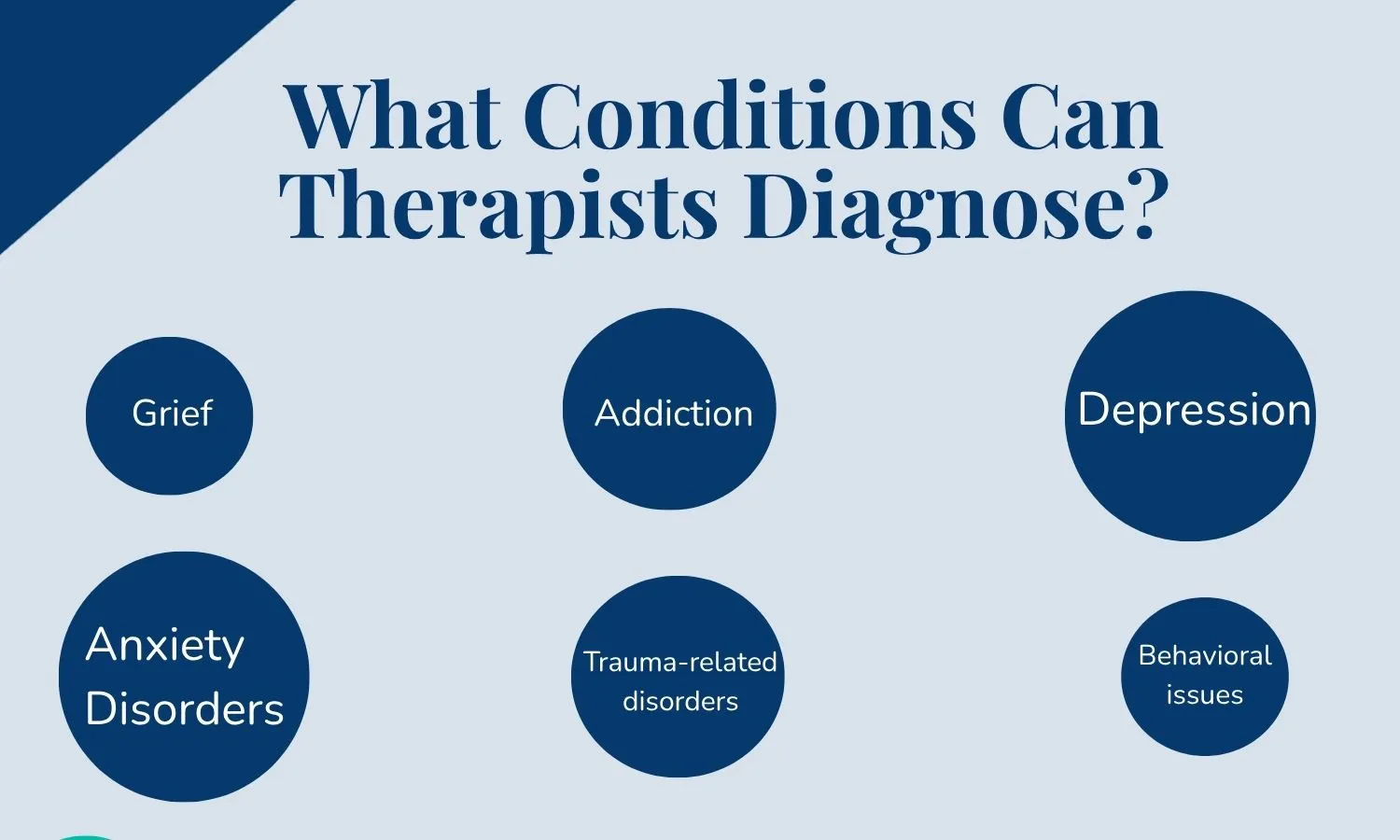
A licensed therapist will be able to use the criteria in the Diagnostic and Statistical Manual of Mental Disorders (DSM-5 TR) to help determine whether you have one or more of the following types of mental health problems:
- Grief
- Addiction
- Depression
- Anxiety Disorders
- Behavioral issues
- Trauma‑related disorders (such as post‑traumatic stress disorder)
Although the licensed therapist is qualified to help identify and address your symptoms through counseling, they are unable to write prescriptions for medication.
However, if it is determined that your symptoms require an examination by a medical doctor or need to be managed with medication, your licensed therapist may refer you to either a psychiatrist or other medical professional.
Read More: Why is Therapy More Expensive?
How Does the Therapeutic Diagnostic Process Look Like?
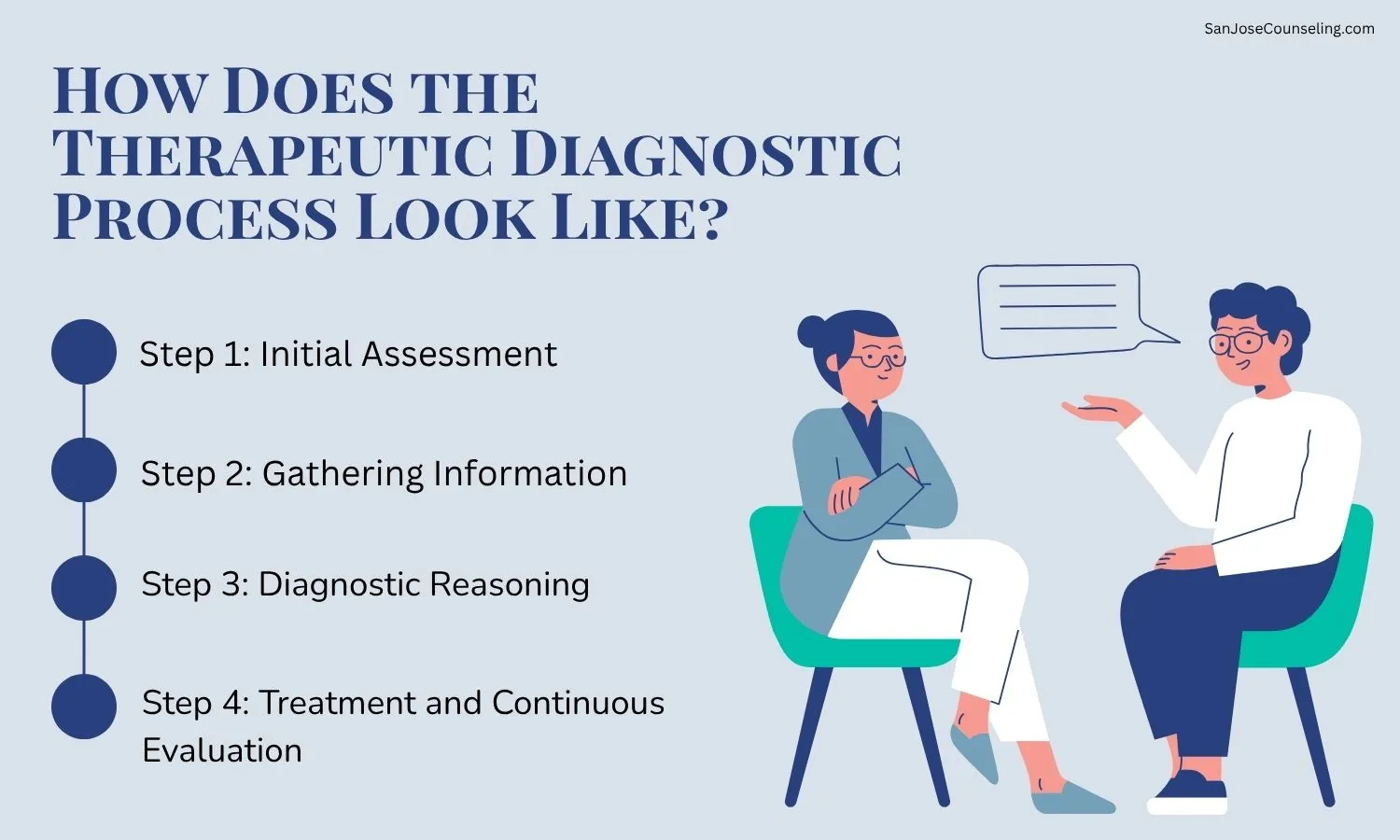
At San Jose Counseling, we collaborate with you to establish an understanding of what symptoms you are experiencing, how they may have developed from past experiences, and what you are currently struggling with. This is to help us identify the issue, develop a clear plan for treatment, and initiate the recovery/healing process.
San Jose Counseling's diagnosis process is a structured and organized process that involves four easy-to-follow steps:
- Step 1: Initial Assessment
The initial assessment where you have an open discussion with the therapist about what brought you to counseling, what you’d like to be addressed, and what you hope to gain from the process. - Step 2: Gathering Information
We gather information to form a complete map of your mental history (if needed). This is done with questionnaires and observing your behavior during conversations. - Step 3: Diagnostic Reasoning
Our therapists compare your symptoms and other factors we observed to the criteria listed in the Diagnostic and Statistical Manual of Mental Disorders, Fifth Edition, Text Revision. - Step 4: Treatment and Continuous Evaluation
With our findings, we can then create a therapeutic plan to help manage your condition, adjusting the plan as you continue to grow.
How Do I Decide Between a Therapist, Psychologist, and Psychiatrist?
At San Jose Counseling, we collaborate with you to establish an understanding of what symptoms you are experiencing, how they may have developed from past experiences, and what you are currently struggling with. This is to help us identify the issue, develop a clear plan for treatment, and initiate the recovery/healing process.
San Jose Counseling's diagnosis process is a structured and organized process that involves four easy-to-follow steps:
Therapist
A good choice for those experiencing relationship (platonic, romantic or professional) issues, stress, anxiety, or major life changes, therapists (such as licensed marriage and family therapists or counselors) will utilize approaches including but not limited to; cognitive behavioral therapy, emotionally focused therapy, etc. in guiding their clients' treatment plans.
Psychologist
Psychologists specialize in both assessment (testing) and therapy of complicated mental health problems.
Psychiatrist
Psychiatrists are medical doctors that use the medical model to assess and diagnose your condition(s), and if necessary, they can also write prescriptions for medications for your condition(s).
There may be times when all three professionals work with one another as a team, providing you with the evaluations, therapies and medical treatments you need.
Conclusion
Yes, a number of licensed therapists are permitted by their education/training and/or the laws in the state where they practice to make a diagnosis for a mental health condition.
They are required to use professional evaluation methods and guidelines set forth in the Diagnostic and Statistical Manual of Mental Disorders (DSM) Fifth Edition, Text Revision to determine your symptoms and develop your treatment plan.
Most therapists, however, are unable to write prescriptions; nonetheless, a therapist can assist you in understanding your condition, and initiate appropriate therapy.
The therapist may also assist you in identifying whether you need medication and/or further testing to fully treat you. In such cases, the therapist may work with a psychologist or psychiatrist to assure that you receive comprehensive care.
Schedule a free consultation call with Dr. Invia for the next step in your mental health journey.
Dr. Invia A. Betjoseph
A licensed therapist and certified expert in sex addiction and partner trauma, offering compassionate counseling for individuals and couples. With advanced training in trauma therapy, including EMDR and Emotionally Focused Therapy (EFT), the focus is on providing effective, evidence-based treatment to heal emotional wounds, restore trust, and support lasting recovery.
FAQ's-Therapist Diagnose
Q1. Can a therapist diagnose you with a mental illness?
Yes. Many licensed therapists can diagnose mental illnesses using the Diagnostic and Statistical Manual of Mental Disorders, Fifth Edition, Text Revision (DSM-V TR) for diagnosis, however most therapists cannot write prescriptions for medications.
Q2. Can a therapist diagnose autism, depression, OCD, and anxiety?
Yes, many licensed therapists can diagnose you with depression, anxiety, and obsessive‑compulsive disorder (OCD). Autism is generally diagnosed by psychological or medical professionals who have evaluated you.
Q3. Can a therapist diagnose you in the first session?
Generally no, though it happens sometimes. It is common for licensed therapists to evaluate your symptoms and take your history over a period of several sessions, prior to making a final Diagnosis.