Does Overthinking Cause Anxiety?

What is Overthinking and how is It Linked with Anxiety?
Overthinking, essentially, involves being trapped in cycles of repetitive thoughts which do not lead to solutions. These are usually ruminations on past events or worries about what has yet to happen.
On the other hand, an anxious person experiences fear; physical and psychological symptoms such as restlessness, lack of focus, inability to fall asleep, muscle tightness, and/or an extremely fast heart rate.
When overthink and anxiety merge, a lot of people have described the feeling as "your mind continuously scans for potential threats" while "the physical sensations tell you that danger is nearby."
Anxiety models developed from research have shown that excessive worry persists if your brain views uncertainty as a threat. In that way, overthinking creates anxiety through increased fear, stress, and mental overload with each passing day.
Whether you’re facing anxiety or overthinking (causing anxiety), We at San Jose Counseling, California can help you deal with overthinking and anxiety. With us, you will be able to quiet racing thoughts and reclaim peace of mind. Book your free consultation with us.
Ready to calm your anxious attachment? Our skilled therapists at San Jose Counseling specialise in CBT. They can help you overcome anxious attachment, quiet the fear of abandonment, and build secure, healthy relationships. Book your free consultation with us.
The Most Common Ways People Overthink
There are four common ways people overthink, and these include Ruminating, Overanalyzing, Future Tripping, and Self-criticism.
- Ruminating: Ruminating typically involves revisiting a situation to analyze it (oftentimes based upon feelings of guilt, shame, regret).
- Overanalyzing: Over analyzing usually involves breaking down the way an event occurred as well as conversations that have taken place; this is typically done in hopes to find certainty.
- Future Tripping: Future Tripping refers to mentally going through potential "worst case" scenarios prior to an event occurring.
- Self-Criticism: Criticizing yourself creates a negative self-image and continually reinforces feelings of ineffectiveness and/or failure.
Each pattern may occur separately however each will commonly create additional anxiety and over thinking.
| Aspect | Overthinking | Anxiety |
|---|---|---|
| Driver | Need for certainty or control | Perceived threat or danger |
| Location | Mostly mental thought loops | Mind and body response |
| Symptoms | Rumination, indecision, mental exhaustion | Fear, tension, sleep issues, physical symptoms |
| Existence without each other | Can happen without an anxiety disorder | Can occur without obvious overthinking |
| Duration | Often prolonged by repetitive thinking | Can be brief or ongoing, depending on severity |
Knowing the difference allows you to better understand the chaos in the mind; overthinking is merely a way of thinking, while anxiety is a more complex emotion with psychological roots.
Read More: What are anxiety disorders?
What are the Telltale Signs of Overthinking (Leading to Anxiety)?
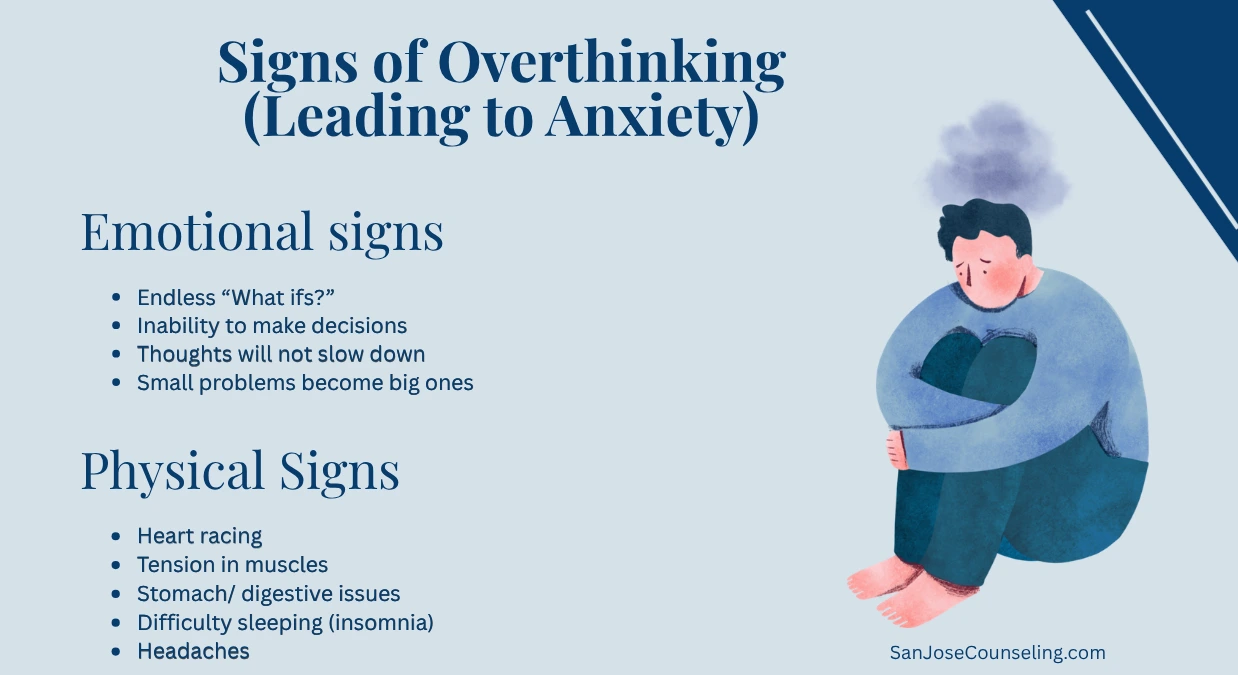
Keeping your mind busy with repetitive thoughts and overanalysis situations does not lead to a productive solution. It does not help you achieve mental clarity. It often results in a heightened sense of anxiety.
Getting the same thoughts over and over again increases stress and anxiety. These patterns affect your daily functioning and relationships, and can worsen your symptoms of anxiety and overthinking. Learn more about high functioning anxiety.
Psychological and emotional signs of stress
- Endless “What ifs?”: You picture worst case scenarios with little to no evidence to support the likelihood of such an event occurring.
- Inability to make decisions: Any decision-making process is difficult due to fear or anxiety regarding potential outcomes.
- Thoughts will not slow down: the ability to stop thinking about a particular topic or problem is difficult.
- Small problems become big ones: An individual sees every issue as an opportunity for things to go terribly wrong.
Physical Signs
- Heart racing: The body's fight or flight response takes over.
- Tension in muscles: Muscle tension often in the neck, shoulder area, or jaw.
- Stomach/ digestive issues: Stress can cause physical changes in one's digestive system.
- Difficulty sleeping (insomnia): Worrying too much prevents sleep because the mind remains on alert.
- Headaches: Ongoing mental stress and/or tension can result in frequent headaches.
Does Overthinking Cause Anxiety?
Yes, overthinking causes anxiety, particularly if repeated and difficult to stop. The constant thinking about things, such as what will happen next or whether something is true, creates in our brains an association of thoughts with threats.
Therefore, we trigger our stress response, which keeps our bodies on high alert. Eventually, this creates a cycle of overthinking, then fear, then more overthinking, which makes the overthinking anxiety pattern stronger.
While overthinking and anxiety disorders may occur independently, they tend to be connected to one another and feed off of each other.
Common Overthinking Behavior Fueling Anxiety
- Catastrophizing: expecting the worst possible outcome
- Ruminating: repeatedly thinking about past mistakes
- Being indecisive: struggles with making even simple choices
- Expecting perfection: having unrealistic standards
- Insomnia: disrupted sleep due to constant thoughts
- Overgeneralization: Turning one failure into the broader picture of yourself
- Mental Fatigue: Feeling mentally exhausted from thinking too much
Managing and Curing Overthinking
Chronic overthinking will increase a person's likelihood for developing stress, depression, and an overthinking anxiety disorder (GAD and Social Anxiety Disorder). This may lead to lowered self-esteem in addition to worsening any symptoms related to trauma.
If left untreated, it could potentially contribute to increased mental fatigue, disrupted sleep patterns, and elevated levels of emotional distress.
Managing Overthinking with Therapy
Therapy is a great way to treat anxiety and overthinking because it provides you with an understanding of what your thoughts are doing in relation to emotional response and also gives you strategies for breaking up those cycles of thought.
- Metacognitive Therapy: The goal of metacognitive therapy is to help you think differently about your thoughts vs. what they say.
- Rumination-Focused CBT: This type of therapy targets those negative thought patterns that you get stuck in over and over again.
- Anxiety Therapy: This type of therapy will decrease your body's and mind's reactions to overthinking.
- Acceptance-Based Therapy (ACT): Helps teach individuals how to notice their thoughts but not react to them.
In addition to other treatments, medication could be used if your symptoms are chronic, or if there is evidence that your overthinking has developed into full blown clinical anxiety.
If you are experiencing daily impairment such as panic attacks, sleeping problems due to overthinking, etc., seek professional assistance.
Managing Overthinking with Self-Help Strategies
Building control over your thought patterns will help you develop a way of reducing the intensity of overthinking as well as anxiety:
- Grounding technique: The 5-4-3-2-1 method; Will keep you in the present moment.
- Set worry time (10-20 mins): Limit the amount of time you spend on thinking about your worries.
- Box Breathing or 4-7-8 Breathing: will help calm down your nervous system.
- Improve decision making: Limit your options for decision-making so that you don't end up over-analyzing them.
- Challenge distorted Thinking: Using CBT techniques to replace extreme thinking with more rational thinking.
These strategies are only effective if you stick to them consistently. With them, you can manage overthinking, as long as it's not severe. If severe, seek professional help immediately.
Stop Suffering and Get The Peace of Mind with San Jose Counseling
With our counseling services at San Jose Counseling, we will help you break through the cycle of anxiety and overthinking that leads to burn-out, stress, and low self-esteem.
We offer an online program for treating anxiety and overthinking with the flexibility to work from anywhere in California, allowing you to avoid delays and access support when you need it.
With this online therapy program, you'll learn how to stop ruminating (over-thinking) on things, question "what ifs", and learn new ways to process intrusive thoughts.
The goal of this program isn't to stay in an endless loop of anxious thoughts; instead, you'll develop practical tools and strategies to gain back control of your thinking and increase clarity in your daily life.
Book a free consultation with San Jose Counseling today!
Dr. Invia A. Betjoseph
A licensed therapist and certified expert in sex addiction and partner trauma, offering compassionate counseling for individuals and couples. With advanced training in trauma therapy, including EMDR and Emotionally Focused Therapy (EFT), the focus is on providing effective, evidence-based treatment to heal emotional wounds, restore trust, and support lasting recovery.
FAQs
Q1. What are the dangers of overthinking?
Thinking too much causes stress and worsens anxiety over time. It also disrupts sleep, affects how you make decisions and can lead to depression, burnout, low self esteem etc., in extreme cases of over thinking.
Q2. What is the root cause of overthinking?
You may over think because you feel like you need control over things that are unpredictable, or because of past experiences (trust issues), or because of cognitive distortions (negative thinking). These patterns will keep your mind focused on perceived threats which cause anxiety.
Q3. Is overthinking a form of OCD?
No. But it can occur with OCD. Over-thinking is not the same as having OCD. OCD involves getting intrusive thoughts and compulsions. While over thinking can result from severe anxiety disorder; it may require professional evaluation.