CBT for Anxious Attachment Style

What is Anxious Attachment Style (in Relationship)?
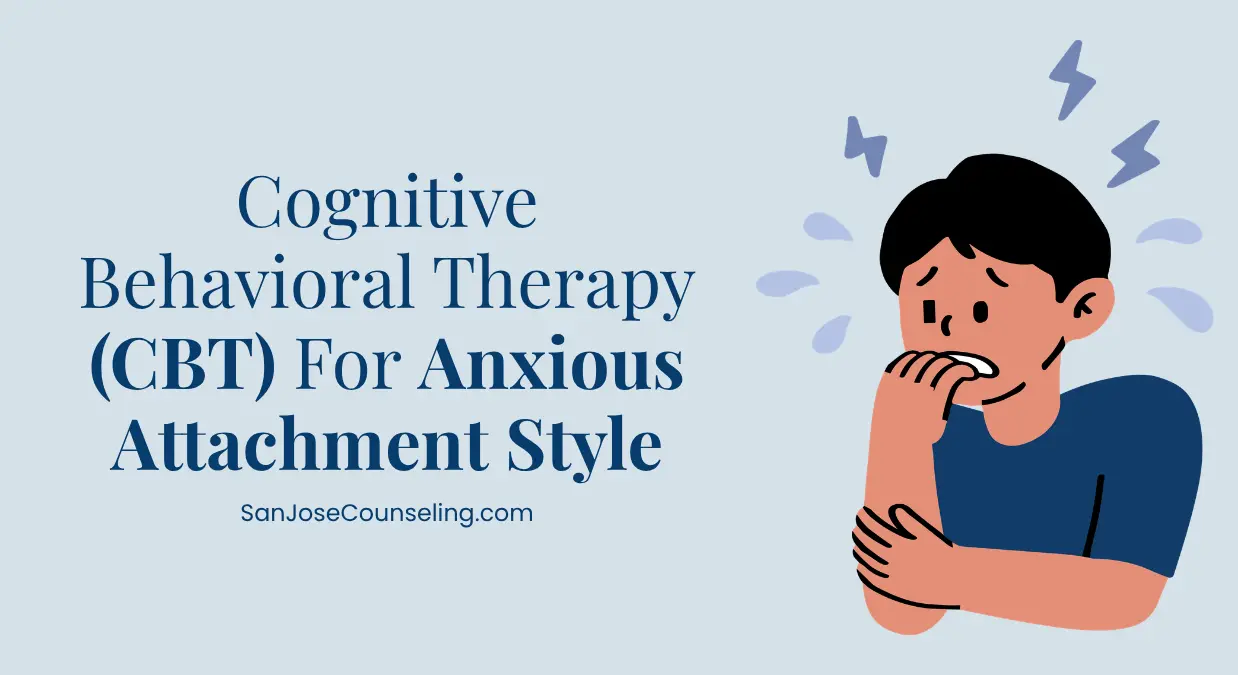
Anxious attachment is an insecure attachment style. There are three types of insecure attachment; anxious, avoidant and fearful-avoidant.
According to attachment theory, the way you develop attachment (the way you experience closeness and feel about safety) will determine which attachment type you have.
When referring to adults, this can be termed "anxious-preoccupied" whereas when referring to children this can be termed "anxious-ambivalent."
This is not a diagnosable condition in the DSM-V, however, it has been correlated to various forms of anxiety disorders and relationship problems.
Adults who identify with this attachment type tend to seek a high level of closeness/dependence with their romantic partners while fearing that they will abandon them.
As a result of these two fears (a desire for closeness and a fear of abandonment), individuals develop excessive emotional dependence on their partners.
Thus creating unstable feelings of insecurity despite being in what would appear to be healthy/stable relationships.
Ready to calm your anxious attachment? Our skilled therapists at San Jose Counseling specialise in CBT. They can help you overcome anxious attachment, quiet the fear of abandonment, and build secure, healthy relationships. Book your free consultation with us.
What are the Signs and Causes of Insecure Anxious Attachment Style?
You may notice anxious attachment symptoms across different areas of your life:
Behaviorally:
- Constantly seeking reassurance/validation from your partner.
- Difficulty tolerating time away from your partner; clingy or overly dependent on your partner.
Emotionally:
- Excessive fear of abandonment/rejection.
- Low self-esteem/self-worth. Learn more about boosting self-esteem.
In Relationships:
- Jealousy/suspicion with little/no reason for concern
- Overanalyze your partner's actions and require consistent communication.
What Causes Anxious Attachment and How it Affects?
When a caregiver has been unpredictable throughout an infant's first years (responsive at times; unresponsive at other times), that child will learn to desire closeness to others yet be fearful of being rejected.
A pattern such as this can grow across many relationships and be maintained by "triggers" such as physical distance from someone you care about, delayed communication, or perceiving some form of neglect. Structured support is commonly required for adult anxious attachment recovery.
Effects on your daily life:
- Overall Well-Being: Anxiety/Fear/Stress related to constant worrying
- Self-Esteem: Need for External Validation
- Productivity at Work: Inability to Focus Due to Worry About Relationship Issues
- Family: Increased Sensitivity in Close Relationships
- Romantic Relationships: Overthinking/Clingy Behavior/Abandonment Fears
Anxious Attachment and Healing Therapy Options
While CBT may be an effective treatment approach, there are other therapeutic options that may provide additional avenues of healing for adult anxious attachment.
Some forms of Attachment-Based Therapy (ABT) focus on changing relational patterns; Eye Movement Desensitization and Reprocessing (EMDR) focuses on processing traumatic experiences that have led to insecure attachment; and, as mentioned earlier, Cognitive Behavioral Therapies (CBT) focus on reducing/eliminating negative thinking, which is so prevalent in individuals who experience Anxious Attachment.
For coping, combine therapy with practical tools:
- Self-Soothing/Mindfulness Practices
- Grounding Techniques (5-4-3-2-1) to Reduce Emotional Spikes
- Reduced Reassurance Seeking Behaviors
CBT works better when one's thoughts lead to their anxiety; EMDR is typically used when someone's symptoms are linked to traumatic experiences.
Ultimately, the most beneficial form of therapy for Adult Anxious Attachment will depend upon an individual's current patterns and the level of symptomatology they are currently experiencing.
Is CBT Right for Your Attachment Style?
Cognitive Behavioral Therapy (CBT), may help in treating anxious attachment. This is especially true if your behaviors are due to overthinking and/or negative thinking patterns that create fears of being rejected or abandoned.
CBT is Likely a Good Fit If You:
- You frequently think too much; continuously seek reassurance
- Your anxieties are caused by your pattern of negative thinking
- You have difficulty maintaining positive self-esteem, and experience self-doubt.
- You would like some clear, practical ways to make changes in your behaviors.
Consider Other Approaches If You:
- Your attachment issues are influenced by unresolved traumatic experiences.
- You often feel overwhelmed by emotions or become "shut down" from experiencing them.
- You have difficulty accessing or processing your feelings.
- You desire more relationship-based or trauma-based (i.e., EMDR, EFT) work.
CBT and Anxious Attachment: Working, Efficacy, and Timeline
CBT (cognitive behavioral therapy) is an evidence-based, goal-oriented model that provides a framework for changing how your cognitive processes, emotions, and behavior interact when it comes to anxious attachments.
The process involves identifying maladaptive beliefs or distorted thinking (for example: "If I am not with my partner at all times, then he/she will leave me") and changing these to a more balanced perspective.
Research has shown that CBT is effective in reducing symptoms of anxiety ranging from mild to severe, and specifically reduces relationship distress as well. In addition to helping you become less reactive emotionally, and help you avoid excessive reassurance seeking behavior, CBT also helps you decrease excessive thinking.
Improvement may be observed in some people in as little as two-three weeks. However, long-term changes in recovery from adult anxious attachment require many weeks/months of continued work with the therapist.
CBT Techniques for Anxious Attachment
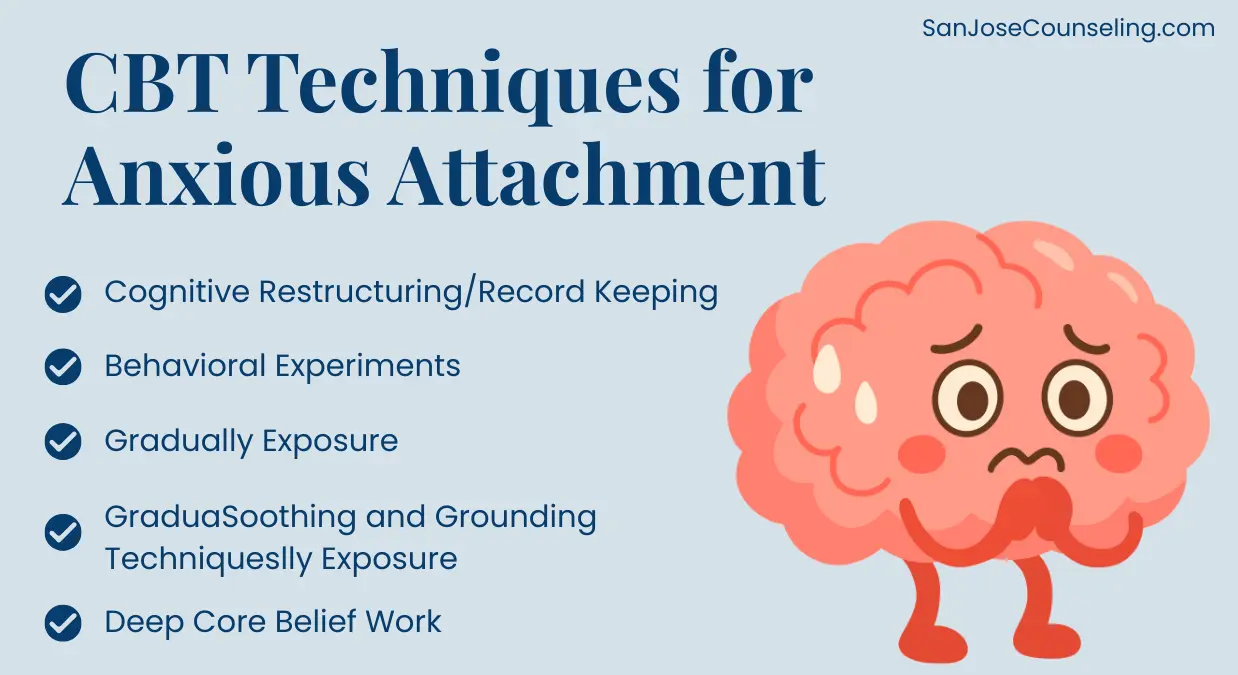
CBT helps individuals who experience insecure attachments by helping them develop ways of managing their thought patterns, feelings, and actions.
- Cognitive Restructuring/Record Keeping: Clients identify and then learn how to counter negative thoughts such as "I will be abandoned", and replace these with a more neutral perspective.
- Behavioral Experiments: Clients test out their fears and apprehensions to find out whether the results they expected are what will happen.
- Gradually Exposure: Gradually exposing clients to feared situations, (i.e. allowing themselves space in their relationship) so that over time they become less sensitive to those situations.
- Soothing and Grounding Techniques: Using self soothing techniques, such as taking slow breaths, using the 5-4-3-2-1 technique to help manage emotional peaks.
- Deep Core Belief Work: Helping clients reshape their core beliefs about their own worth, trustworthiness, and safety to promote long term recovery.
Dr. Invia A. Betjoseph
A licensed therapist and certified expert in sex addiction and partner trauma, offering compassionate counseling for individuals and couples. With advanced training in trauma therapy, including EMDR and Emotionally Focused Therapy (EFT), the focus is on providing effective, evidence-based treatment to heal emotional wounds, restore trust, and support lasting recovery.
Empowering Individuals and Couples to Move from Anxious to Secure Attachment
It's completely feasible to move towards a more securely attached relationship through persistent effort and the right form of treatment for anxious attachment.
The first step is typically to develop the ability to self-soothe, decrease your need for reassurance from others, and develop internal stability (as opposed to solely relying on others).
To self-soothe anxious attachment, you'll use grounding, labeling emotions, and other forms of relaxation when triggered. This will ultimately help to lower the intensity of feelings and provide increased control over those same feelings.
Signs you’re making progress:
- Thoughtfully: less fear of being abandoned; more balance in your thinking
- Behaviorally: reduced clinging and impulsive reactions
- Relationshipally: increased trust; more stability; clearer communication
“Earned Security” means you feel at ease around others without consistently experiencing fear. Anxious Attachment Therapists at San Jose counseling can work with you to speed up development towards earned security. They can also provide you with support to achieve long-lasting changes. Book a free consultation call today!
FAQs
Q1. What is the 3 3 3 rule for anxiety?
The 3-3-3 rule is an anxiety-reducing grounding technique: identify 3 things you can see, 3 things you can hear, and move 3 parts of your body. The goal of this technique is to immediately reduce anxious thinking and overthinking.
Q2. How do you cure anxious attachment?
There is no "cure" for anxious attachment. However, it is treatable. Therapy for anxious attachment will include identifying and treating anxious attachment, increasing self-awareness of your emotions, regulating your emotions, and challenging negative beliefs. Consistent practice and regular therapy sessions are required in order to achieve long-term change.
Q3. What are the 4 C's of attachment?
Connection, communication, consistency, and care. All four of these factors contribute to forming a secure attachment style that reduces or eliminates symptoms associated with anxious attachment.
Q4. What are the 3 C's of CBT therapy?
Thoughts (cognition), actions (behavior), and consequences. In CBT, we focus on how your thoughts affect both your behavior and emotional outcomes.
Q5. What’s the 5 4 3 2 1 method for anxiety?
This is another type of grounding exercise used to calm the nervous system when experiencing high levels of anxiety: identify 5 things you see, 4 things you feel, 3 things you hear, 2 things you smell, and 1 thing you taste.
Q6. What are the 3 C's of anxiety?
Cognitive (your thoughts), emotional (your feelings), and physical (body responses). Each of the three components work together to create and maintain patterns of anxious attachment as well as anxiety.